Blakiston Falls: A Peaceful Hike with a Wild Surprise
There are hikes where you spend the entire time watching the scenery. And then there are hikes where you start watching the scenery and wondering what might be watching you.
Our hike to Blakiston Falls in Waterton Lakes National Park was a little bit of both. The trail begins at the Red Rock Canyon parking lot, making it incredibly easy to combine a visit to Red Rock Canyon with a short hike to one of Waterton’s most beautiful waterfalls. After exploring the canyon, we headed toward Blakiston Falls, expecting a peaceful walk through the forest.
What we didn’t expect was to have our peaceful hike interrupted by a deer sprinting across the trail directly in front of us. And when I say sprinting, I mean sprinting. One second we were casually walking and talking, and the next—WHOOSH!—a deer came flying across the trail. It scared the absolute crap out of us. For a moment, we just stood there trying to figure out what had happened. Then we laughed, but the encounter definitely changed the rest of our hike. Suddenly, every rustle in the bushes became suspicious. Every movement between the trees caught our attention. We had officially entered wildlife-watching mode. And honestly, that’s part of what makes hiking in Waterton so memorable. You’re never completely disconnected from the wild. Even on an easy, well-maintained trail, you’re walking through an ecosystem where wildlife is very much at home.
So while Blakiston Falls was the destination, the journey there became part of the adventure.
Starting at Red Rock Canyon
The trail to Blakiston Falls begins from the Red Rock Canyon parking lot, making it one of the easiest hikes to pair with another attraction during a day exploring Waterton Lakes National Park. If you’re already visiting Red Rock Canyon, you don’t need to get back in the car and drive somewhere else. Simply add Blakiston Falls to your itinerary. From the parking area, the trail begins by crossing Red Rock Creek and Bauerman Creek before continuing into the forest. The transition is almost immediate. The colorful canyon gives way to a quieter landscape of trees, mountain air and the sound of flowing water. And this is where we started settling into the hike. At least until the deer decided to make its dramatic entrance.
A Walk Through a Forest Rebuilding Itself
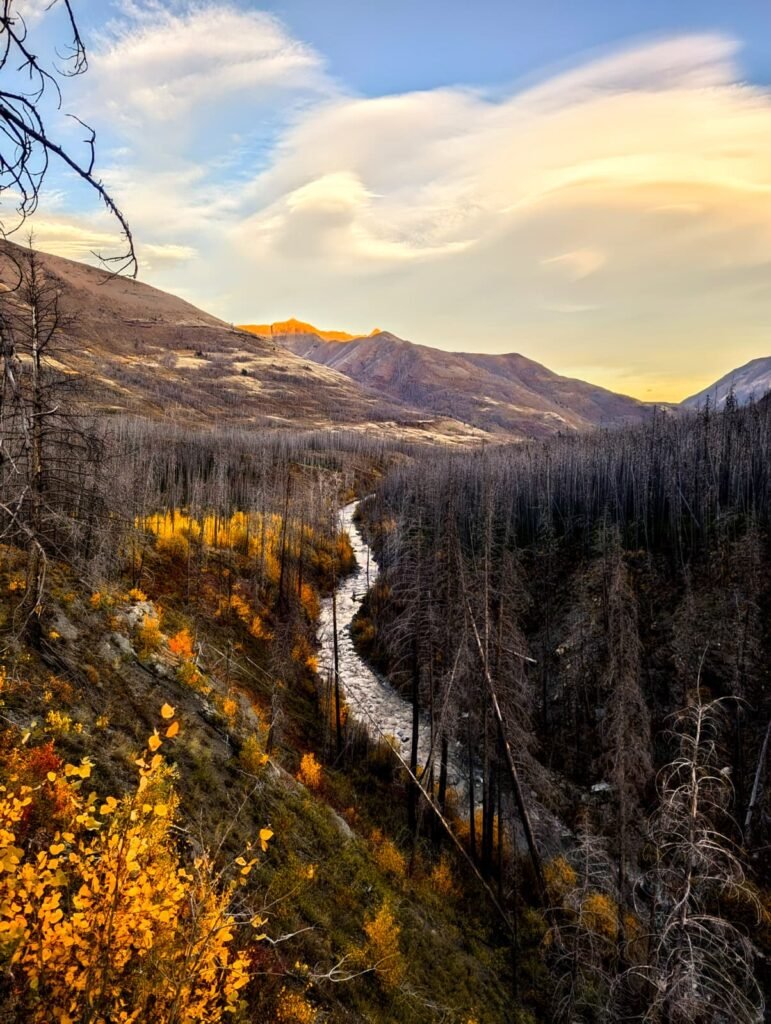
One of the things we found especially interesting along the trail was seeing evidence of past wildfires. Blackened tree trunks still stand among areas of vibrant green vegetation. New trees and plants are growing around the remains of the old forest, creating a landscape that feels both rugged and surprisingly beautiful. It’s one of those scenes that makes you stop and think about how quickly nature can begin rebuilding itself. The burned trees aren’t simply reminders of destruction. They’re also part of a much bigger story—the natural cycle of disturbance, recovery and renewal.
For photographers, this section of the trail is particularly interesting because the contrast between the dark, weathered trunks and the fresh vegetation creates a lot of visual depth. Look beyond the obvious mountain scenery. Sometimes the most compelling photograph is a small detail in the forest.
And Then Came the Deer
If there’s one thing we learned on this hike, it’s that “easy trail” doesn’t mean “pay no attention.” We were walking along the trail, completely relaxed, when a deer suddenly ran straight across our path. It happened so quickly that there was barely enough time to react. Our peaceful forest stroll instantly turned into: “Okay…where did that come from, and where are the rest of them?”
For the rest of the hike, we were on high alert. Every crack of a branch had us looking toward the trees. Every rustle made us wonder if another animal was nearby. Looking back, it’s one of those travel moments that makes a hike much more memorable. And it’s also a good reminder that when you’re hiking in a national park, you are a guest in the animals’ home.
Keep your eyes open, make noise as you hike, give wildlife plenty of space and never approach or feed an animal—even if it looks harmless. Sometimes wildlife doesn’t need to be searched for. It finds you.
Blakiston Falls
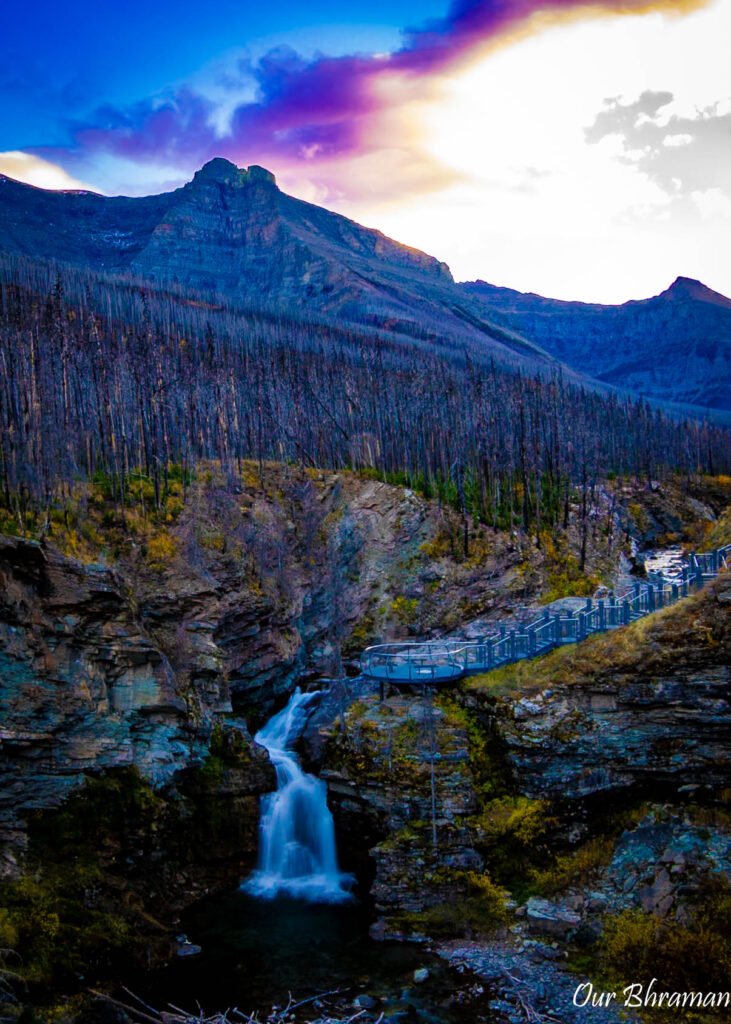
Eventually, the trail reaches the highlight of the hike: Blakiston Falls.
The waterfall tumbles over rugged rock formations surrounded by forest and colorful vegetation, creating one of those scenes that feels almost perfectly designed for a camera. The viewing platform provides a safe place to stop and take in the falls. And after the relatively easy walk through the forest, arriving at the waterfall feels like a satisfying payoff. There’s something about waterfalls that makes people stop talking. You hear the rushing water, look at the surrounding landscape and for a few minutes, everything else seems to disappear. For us, it was also the perfect place to slow down after spending the entire second half of the hike wondering what wildlife might jump out at us next.
Photography Tips
Blakiston Falls is a great place to experiment with different photography techniques.
Try a slower shutter speed
If you have a camera with manual controls, experiment with a slower shutter speed to create that silky, flowing-water effect.
A tripod and neutral-density filter can be especially helpful during brighter conditions.
Don’t forget the forest
The waterfall is the obvious subject, but don’t photograph only the falls.
Look for compositions that include: Burned tree trunks, New green growth, Rocks and flowing water, Forest framing, Colorful foliage, The trail leading toward the falls
These details can tell a much bigger story about the landscape.
Look for foreground interest
Try placing rocks, branches, flowers or vegetation in the foreground to add depth to your images.
Instead of simply photographing the waterfall, create an image that makes the viewer feel like they’re standing on the trail with you.
Visit during fall
If you’re visiting Waterton in autumn, the surrounding foliage can add another layer of color to the scene.
The contrast between golden leaves, dark tree trunks, gray rock and rushing water can make for beautiful compositions.
Don’t forget your wide-angle lens
A wide-angle lens is useful for capturing the waterfall along with the surrounding landscape.
But don’t be afraid to switch lenses and zoom in on details, too. Waterfalls often have interesting textures and patterns that aren’t obvious from farther away.
Blakiston Falls Trail Facts
Location: Waterton Lakes National Park, Alberta
Trail: Blakiston Falls Trail
Trailhead: Red Rock Canyon parking area
Difficulty: Easy
Terrain: Wide, well-maintained and relatively flat
Destination: Blakiston Falls
Best for: Families, beginners and casual hikers
Photography: Excellent
One of the biggest advantages of this hike is its accessibility. The trail is wide, maintained and relatively flat, making it a comfortable option for hikers who don’t want a strenuous mountain climb. It’s also a great choice if you’re traveling with family or simply looking for a shorter hike to add to a bigger Waterton itinerary.
Travel Tip
Combine it with Red Rock Canyon
This is probably the biggest reason to add Blakiston Falls to your itinerary.
Since the trail begins at the Red Rock Canyon parking area, you can easily visit both attractions during the same stop.
Plan some time to explore Red Rock Canyon before or after your hike.