Getting to the SANDEMANs Walking Tour
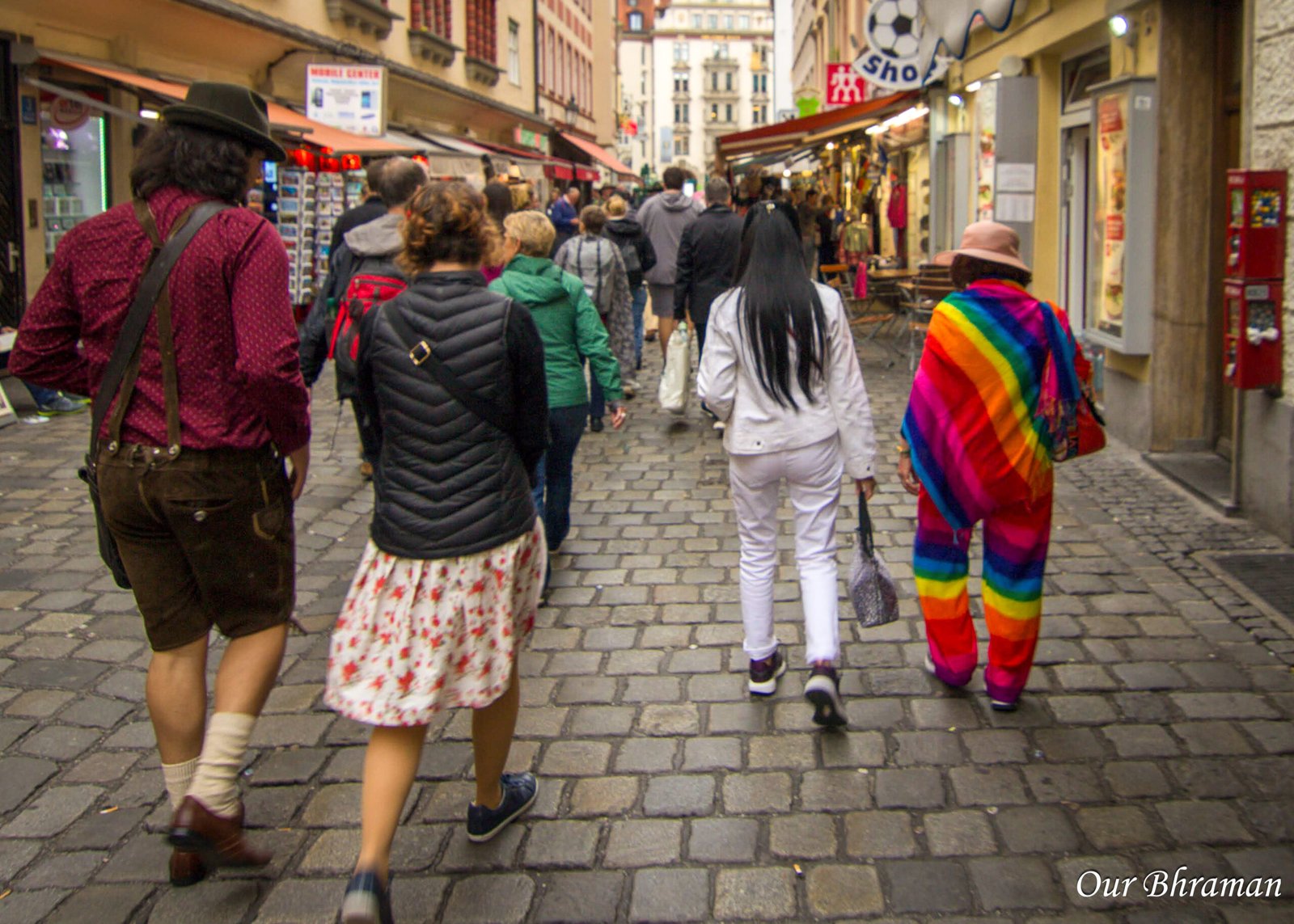
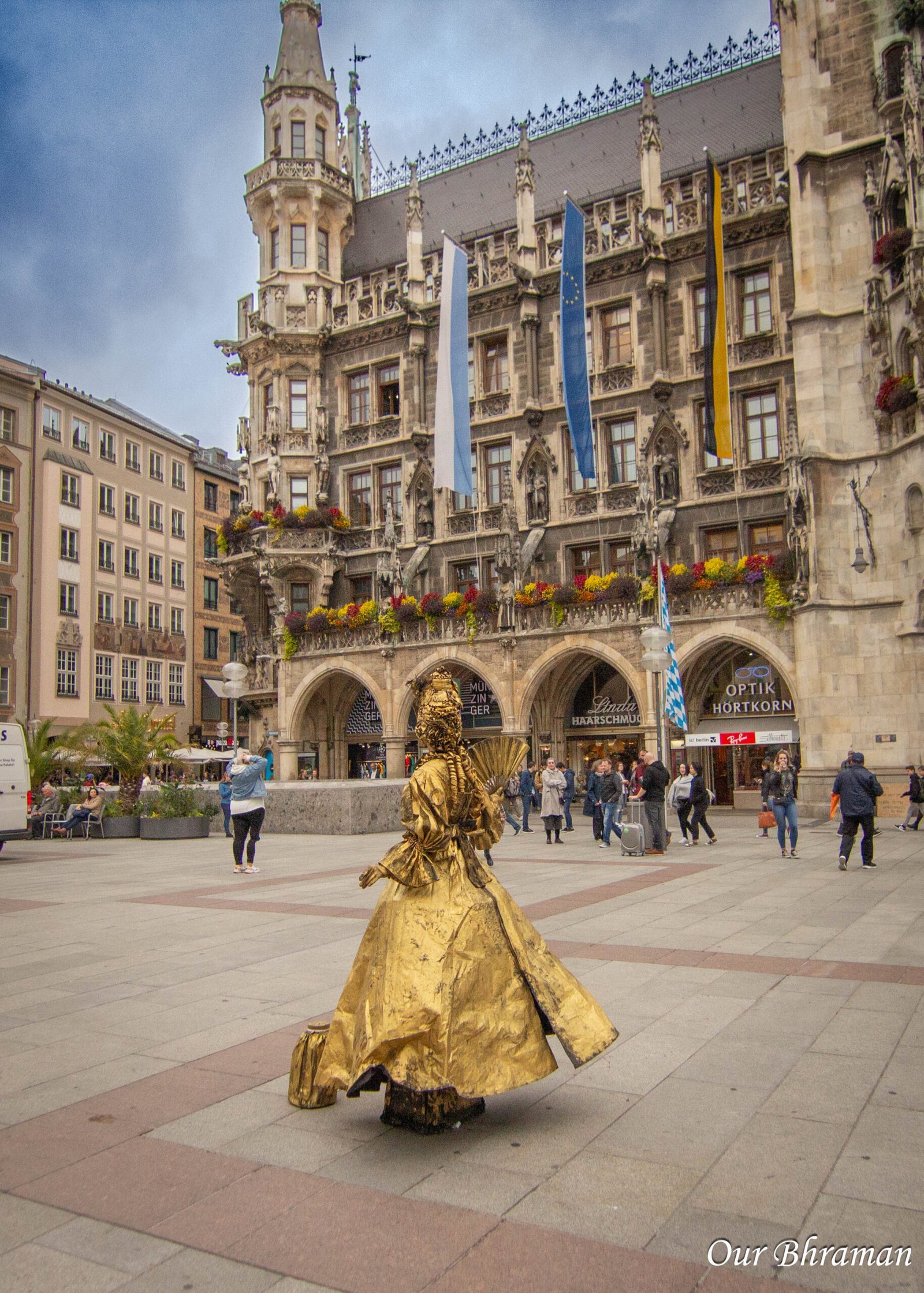
From our hotel, we walked through Munich toward Marienplatz, where we were meeting for the free walking tour. Even before the tour started, the walk gave us a chance to see some of the city.
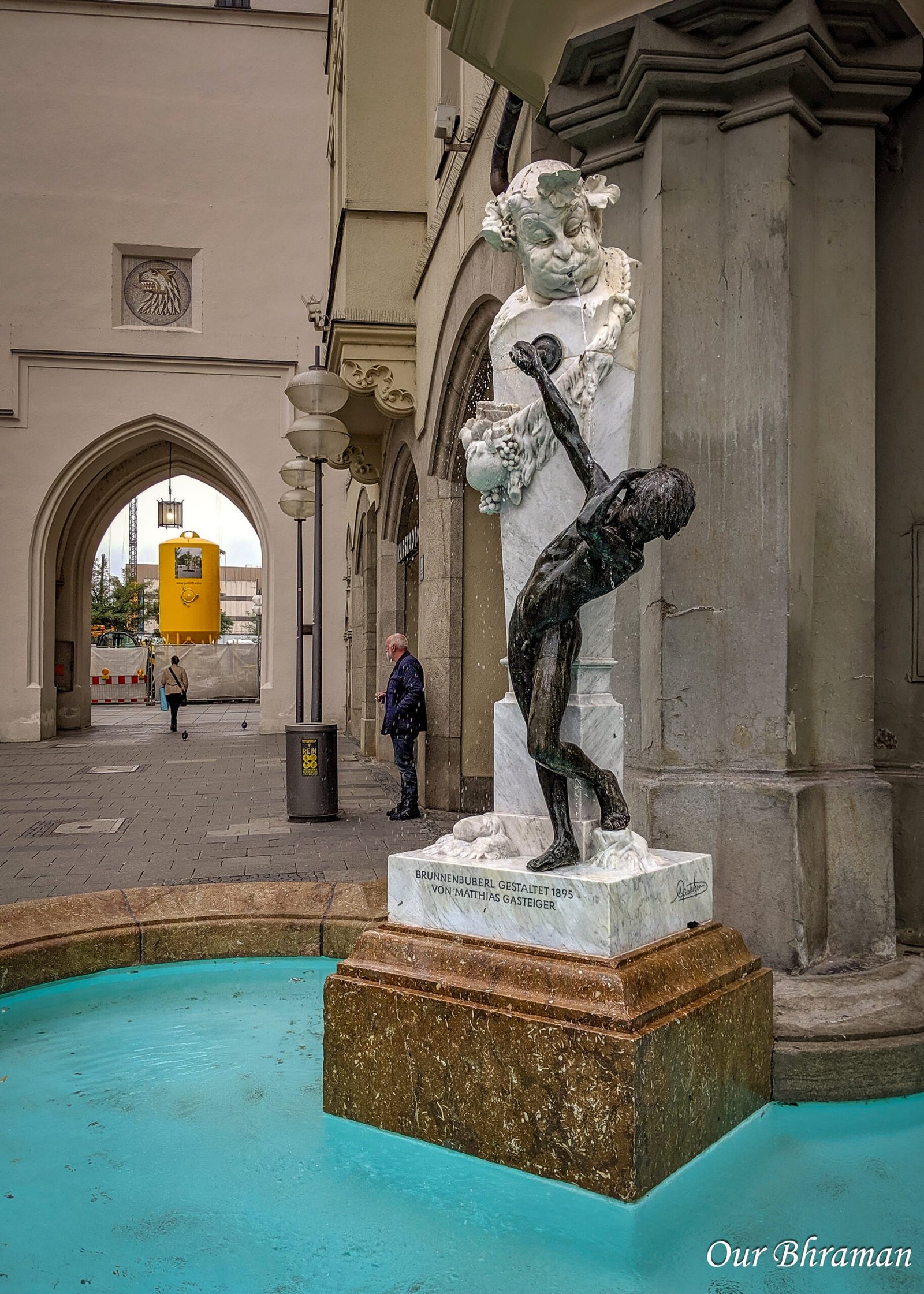
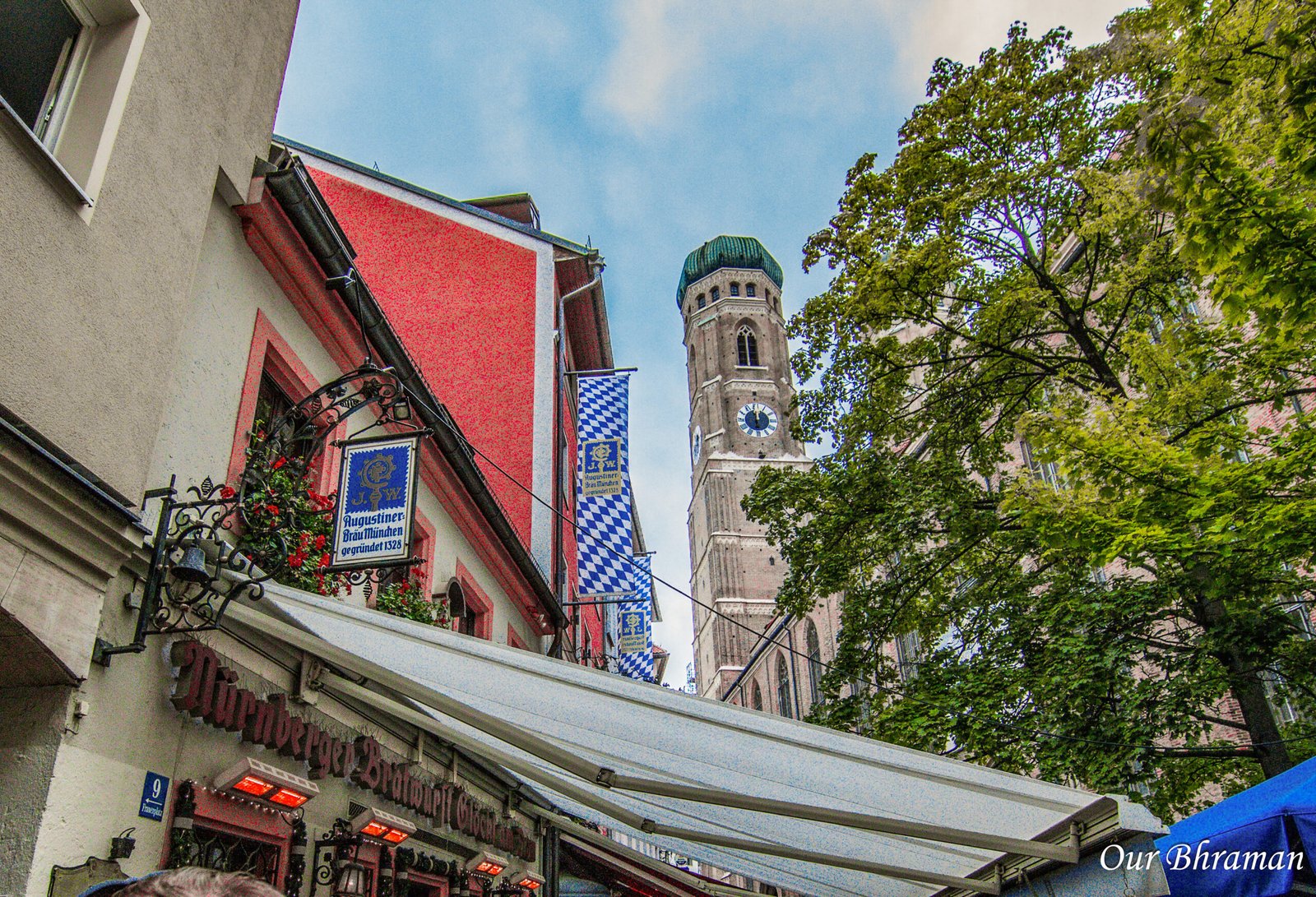
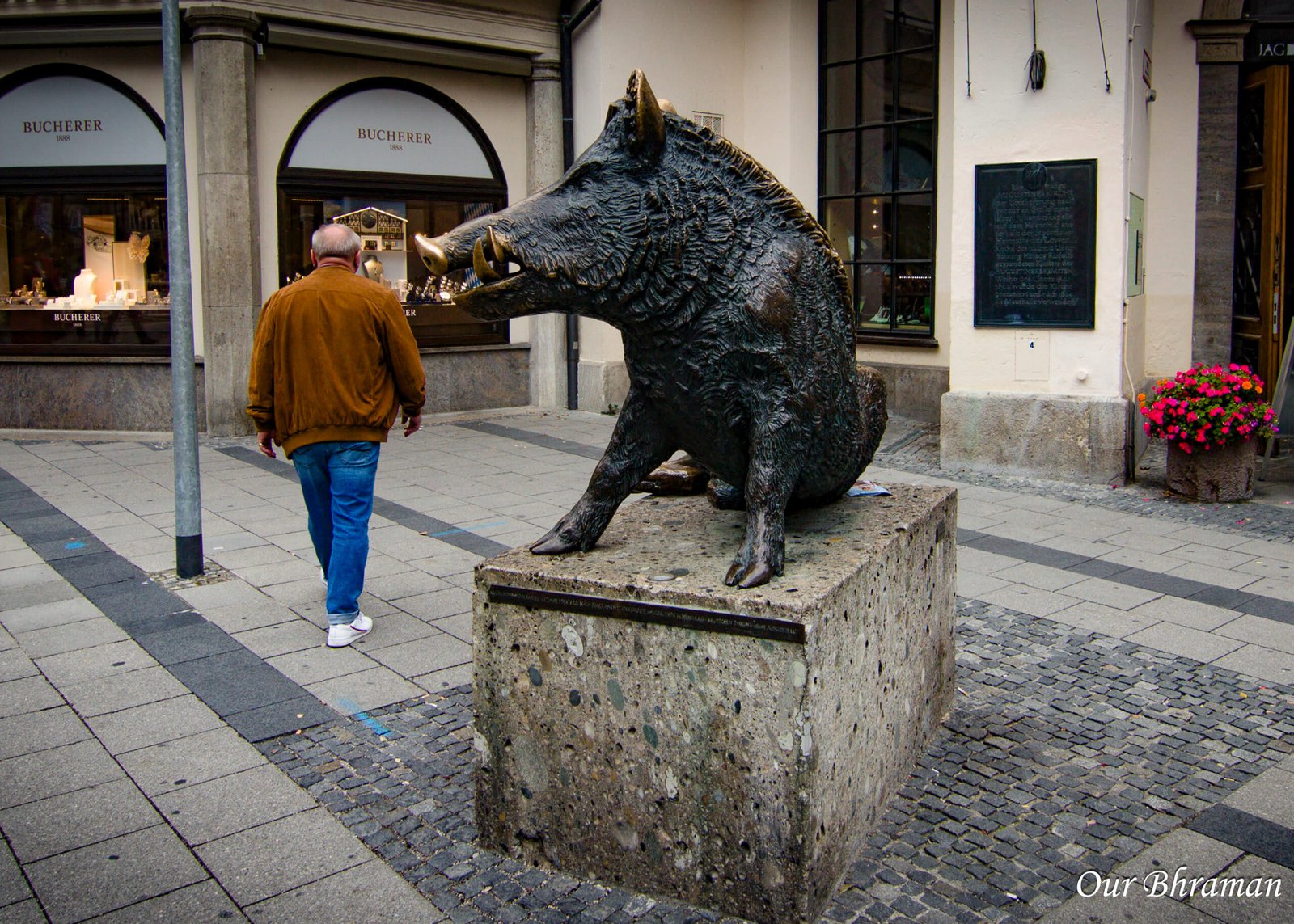 Along the way, we passed Karlsplatz (Stachus) and the Stachus Fountain, located in the heart of the busy square. We also came across the Brunnenbuberl fountain, the Sitzender Keiler sculpture, colorful streets, and beautifully detailed buildings that made the walk feel like part of the sightseeing itself.
 By the time we reached Marienplatz, we had already seen several different sides of Munich. It was here that we found the SANDEMANs red umbrellas and met our guide, Matt.
Marienplatz
He was one of those guides who could make history feel less like a lesson and more like a story. He connected the buildings and streets around us to Munich’s royal past, everyday life, World War II, Hitler and the Nazi era, and some of the city’s lesser-known stories.
What made the tour memorable was that we weren’t simply looking at buildings. Almost every stop had a story behind it, and Matt gave us a reason to look a little closer.
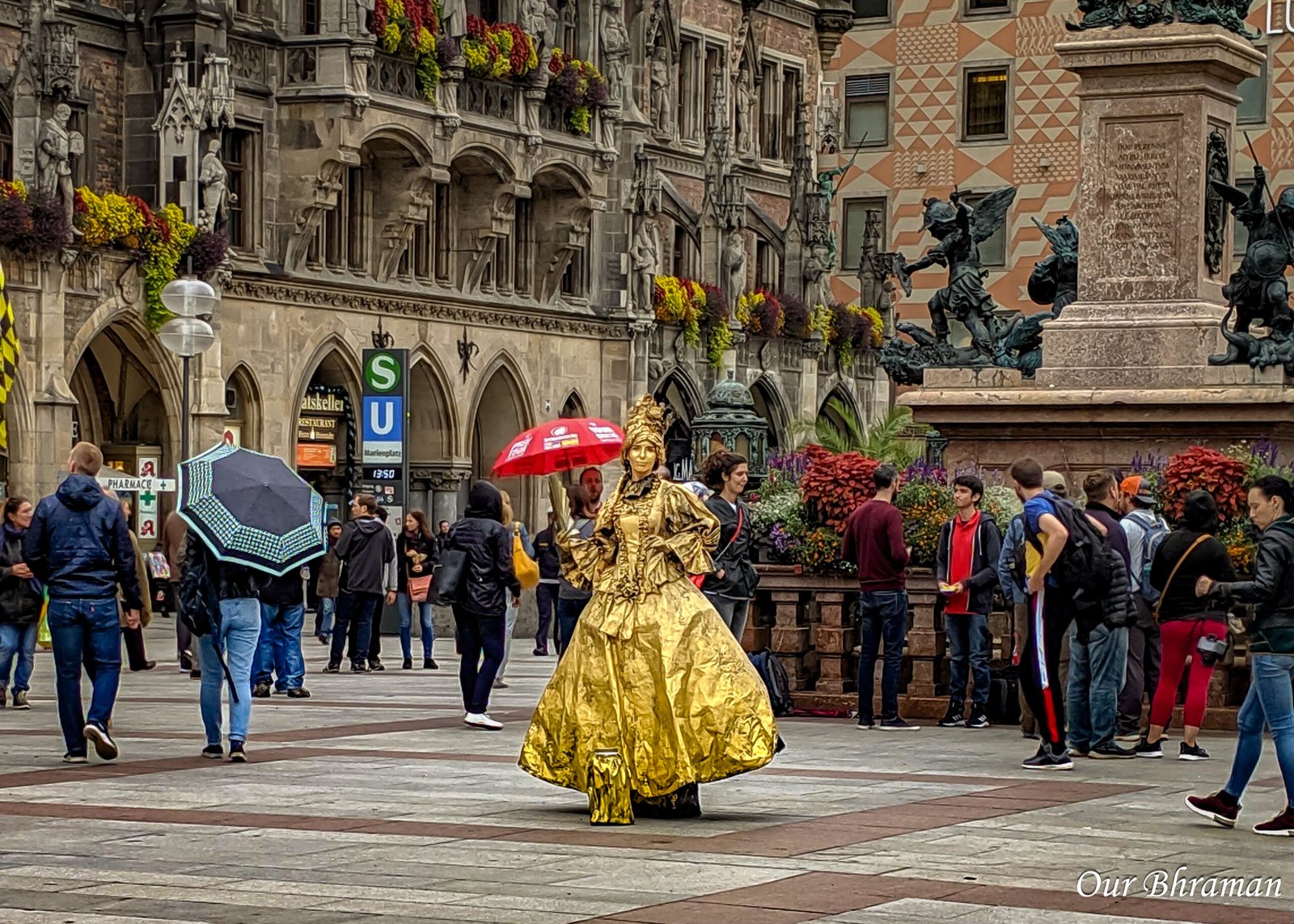 We began at Marienplatz, the heart of Munich’s old town. The square has been at the center of the city since its founding in 1158, and today it is surrounded by some of Munich’s most recognizable buildings, including the New Town Hall and Old Town Hall.
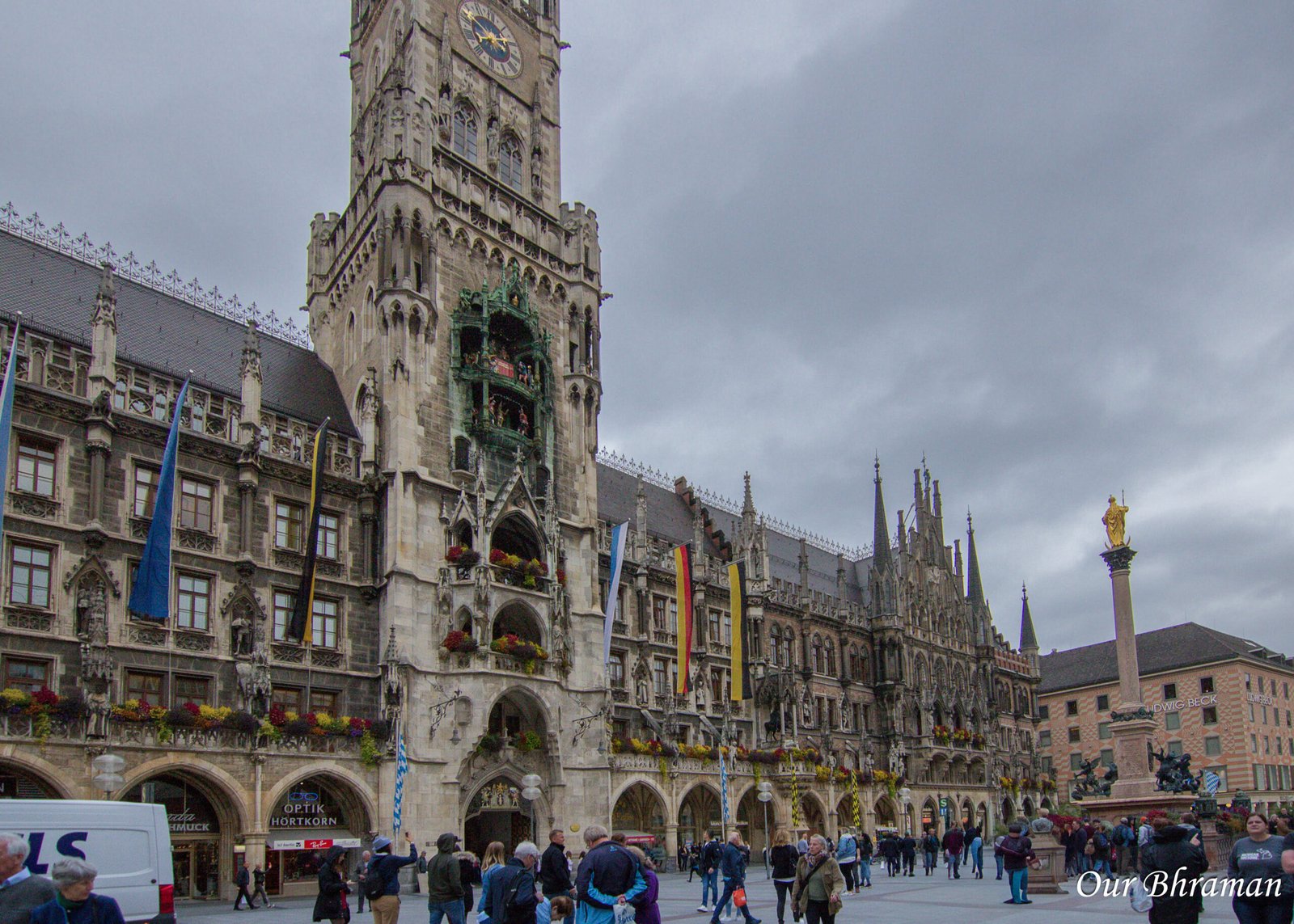
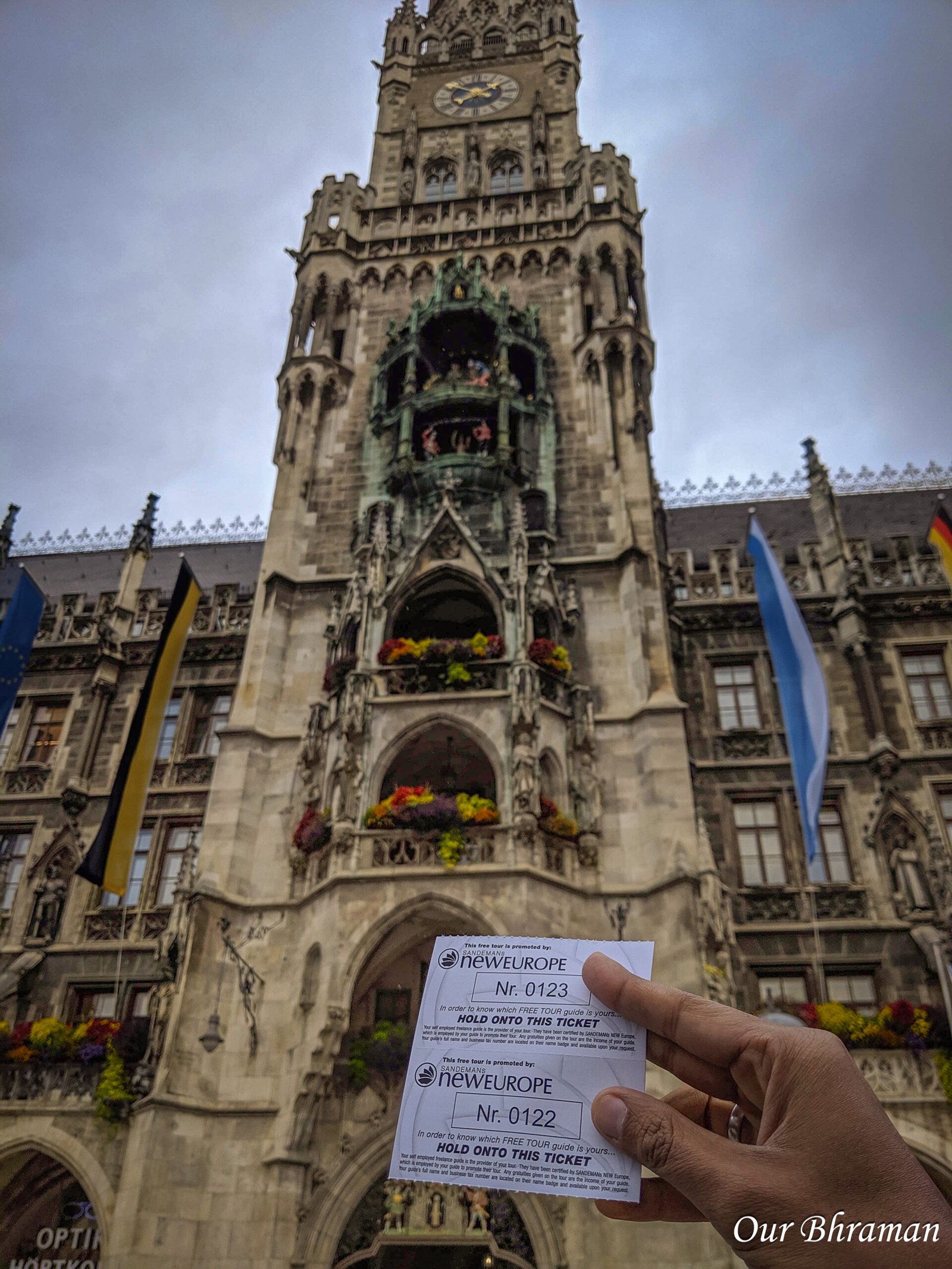 Standing in the square, the first thing that caught our attention was the elaborate façade of the New Town Hall. It looks centuries older than it actually is, but it was built between 1867 and 1909 in the Neo-Gothic style. Matt explained how the famous Glockenspiel in the tower tells stories from Munich’s past rather than simply functioning as a clock.
The figures depict, among other things, the 1568 wedding of Duke Wilhelm V and Renata of Lorraine and the traditional Schäfflertanz, or Coopers’ Dance. According to the tradition, the dance represented the return of joy to Munich after a plague epidemic.
Looking up at the tower while listening to the story made the building feel much more interesting than simply taking a photograph of it.
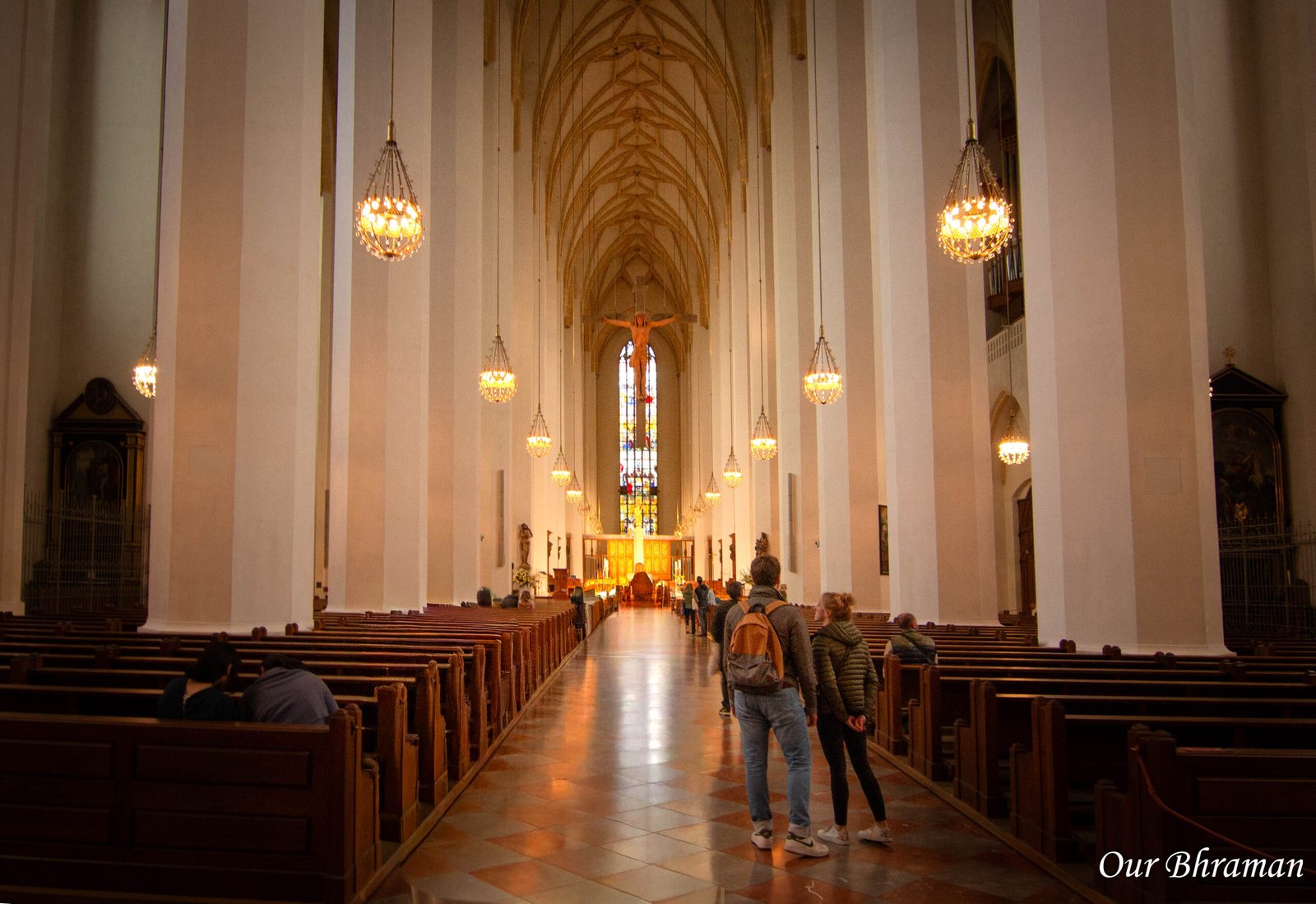
From Marienplatz, we continued toward the Frauenkirche, one of the defining landmarks of Munich’s skyline. Its twin towers and distinctive domed tops are difficult to miss.
Matt shared some of the history behind the cathedral, including how quickly the main building was completed for its time—construction began in 1468 and the church was essentially completed in 1488, apart from the tower tops. The distinctive domes were added later, in 1525.
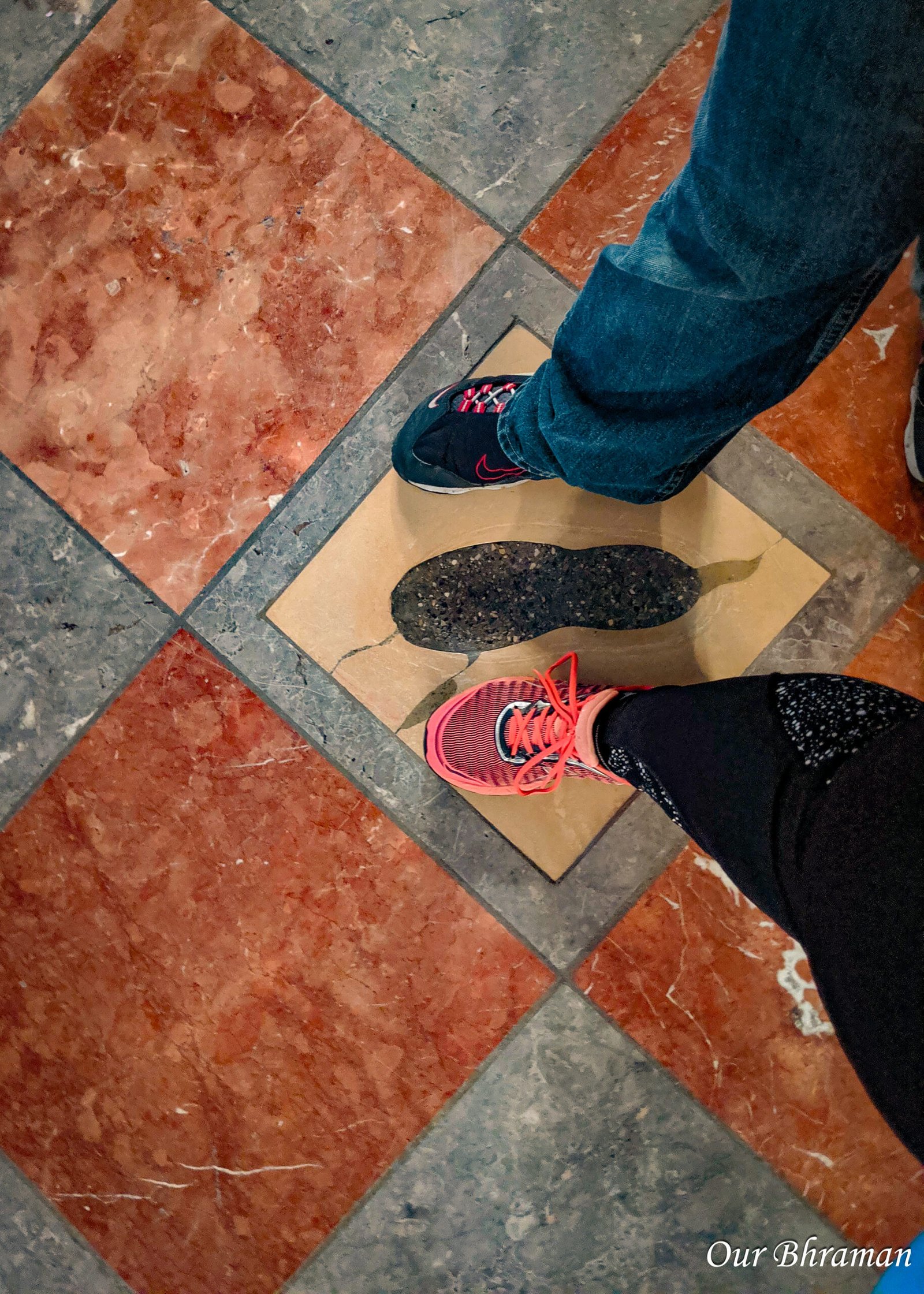 But the part that caught our attention was the famous “Devil’s Footprint.” A dark footprint-shaped mark on the floor near the entrance is connected to one of Munich’s best-known legends. According to the story, the Devil believed the architect had built a church without windows. He later discovered that the windows were simply hidden from his initial viewpoint by the columns and the original high altar.
It was exactly the kind of story that made the walking tour fun—part history, part architecture, and part local legend.
Juliet at Marienplatz
While walking through Marienplatz, our guide pointed out something we would have easily missed—the bronze statue of Juliet Capulet, tucked near the Old Town Hall.
Matt shared the local story behind the statue and explained how it is connected to Verona, Italy, Munich’s twin city. The statue is a copy of the famous Juliet statue in Verona and has become a small tradition of its own. Visitors often leave flowers and touch Juliet’s right breast, which has become noticeably shiny from years of visitors following the tradition.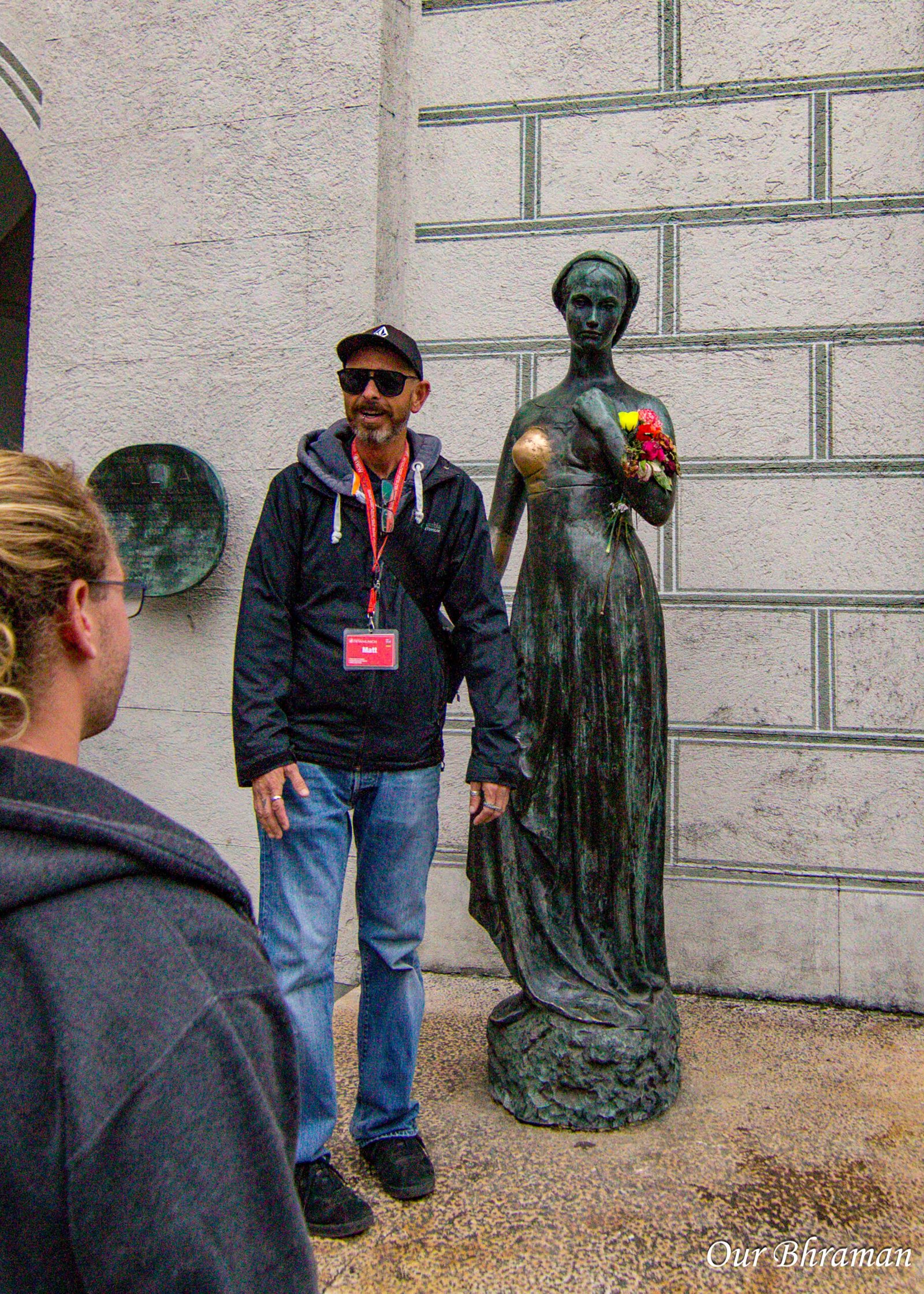
What made this stop memorable for us was not just the statue itself, but the story behind it. Without our guide pointing it out, we probably would have walked right past it. It was one of those small details that made the walking tour feel different from simply exploring Munich on our own.
Sometimes, it is these unexpected little stories that stay with us long after the big landmarks.
Hofbräuhaus München
One of our stops during the walking tour was the famous Hofbräuhaus München at Platzl 9. From the outside, it looked like another historic building in Munich’s old town, but stepping inside was a completely different experience. The Hofbräuhaus was founded in 1589 by Duke Wilhelm V of Bavaria, originally to supply beer to the Bavarian court. It eventually opened to the public in 1828, turning the royal brewery into the beer hall and tavern that became part of Munich’s identity.
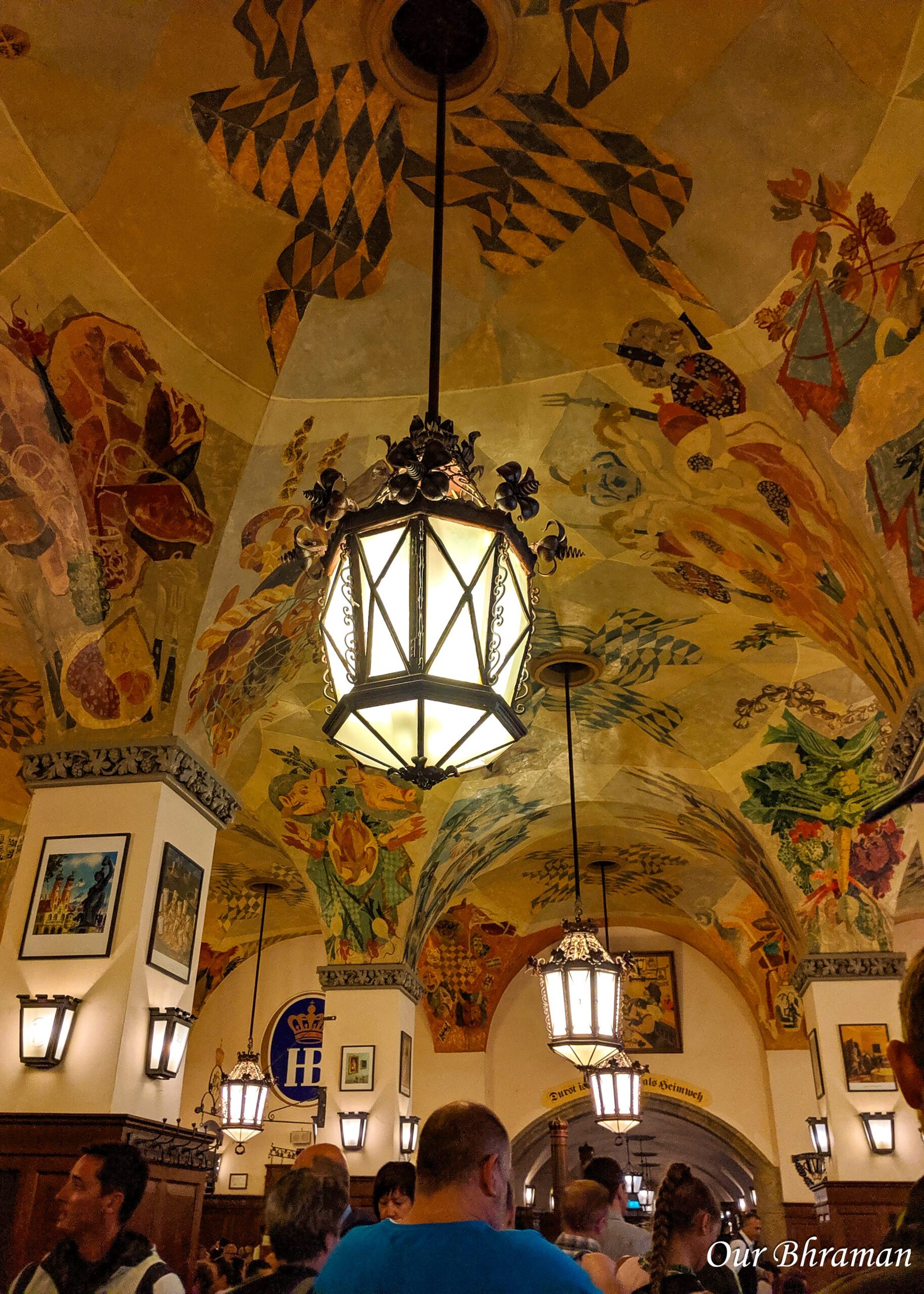
Inside, the Schwemme, the main ground-floor beer hall, was exactly what we imagined a traditional Bavarian beer hall would look and feel like. High vaulted ceilings, long wooden tables, large communal seating areas, historic details, and the sound of traditional Bavarian music created a lively atmosphere. Some of the wooden tables date back to 1897, and many carry initials and messages carved into the wood over the years. The hall can accommodate up to 1,300 guests, so even during a short visit, it was easy to understand how this place became such a famous gathering spot.
 And, of course, there was the beer. Hofbräuhaus serves its own Hofbräu beers, including Hofbräu Original, a Munich-style Helles; Hofbräu Dunkel, a darker, maltier beer with roots going back to the brewery’s early days; and Münchner Weisse, a refreshing Bavarian wheat beer. Seasonal beers are also part of the selection.
For us, though, the stop was about more than having a beer. We were taking in the atmosphere—the wooden tables, Bavarian music, traditional clothing, servers carrying large beer mugs, and groups of people sharing tables and conversations. It felt less like simply visiting a restaurant and more like stepping into a piece of Munich’s living beer-hall culture.
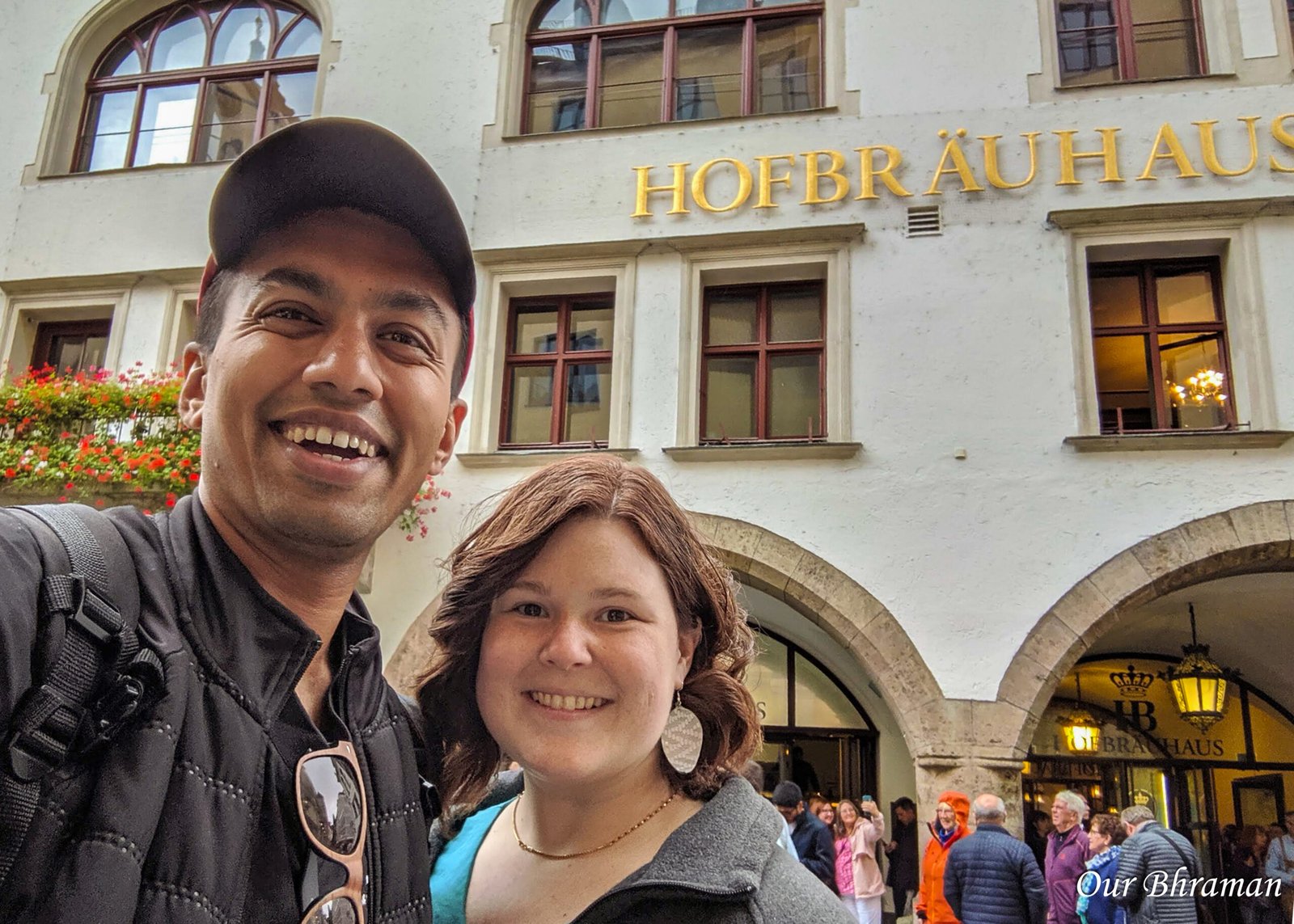 Our guide’s stories had already given us a different way of looking at Munich, and Hofbräuhaus was a fitting stop along the way. We could see how history, food, beer, music, and social life all come together here. Even with a short stop, Hofbräuhaus gave us a glimpse of the Munich we had come to experience—not just through its famous landmarks, but through the places where people gather.
Fünf Höfe — A Different Side of Munich
We then walked through Fünf Höfe, or the “Five Courtyards,” and the atmosphere changed completely.
Instead of medieval streets and historic churches, we found a modern architectural complex built into the historic city center. The project transformed an enclosed block into a series of courtyards and passages filled with shops, cafés, restaurants, and contemporary architectural details. It was completed in 2003 and designed by Herzog & de Meuron.
This was a nice reminder that Munich isn’t simply a preserved historic city. Old and new architecture sit surprisingly close together.
Max-Joseph-Platz
From the lively atmosphere of Hofbräuhaus, our walking tour took us to Max-Joseph-Platz, where the mood changed completely. The square is surrounded by some of Munich’s most important buildings, including the grand National Theatre, the Munich Residenz, and historic buildings along the edges of the plaza.
In the center of the square stands the seated bronze statue of King Maximilian I Joseph, the first King of Bavaria. Our guide pointed out the unusual detail that the king is sitting rather than standing or riding a horse. There is an interesting story behind it: the original design was changed, and the seated version was eventually commissioned by his son, Ludwig I. The official explanation is also connected to Maximilian Joseph’s role in accepting Bavaria’s first constitution in 1818.
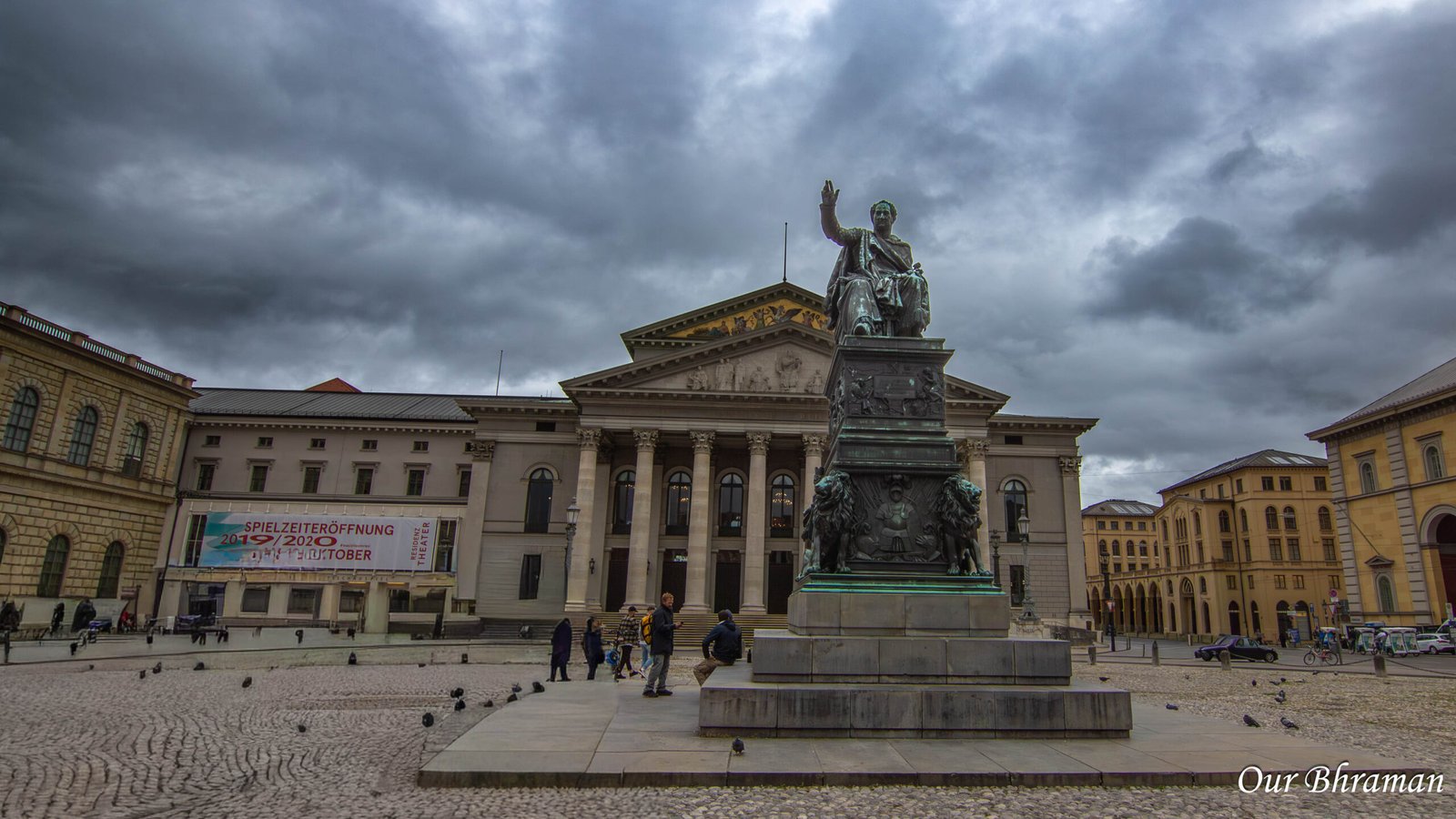
Standing there, we could see how different parts of Munich’s history came together in one place. The Residenz represented the Bavarian royal family, the National Theatre represented Munich’s cultural and musical traditions, and the statue in the middle brought the history of Bavaria’s monarchy right into the square.
For us, this was another reminder of why we enjoyed having a guide. We could have walked through this beautiful square, taken a few photographs, and continued on. But with the stories behind the buildings and the people connected to them, Max-Joseph-Platz became more than just another pretty square on our walk through Munich.
Munich Residenz & Kaiserhof
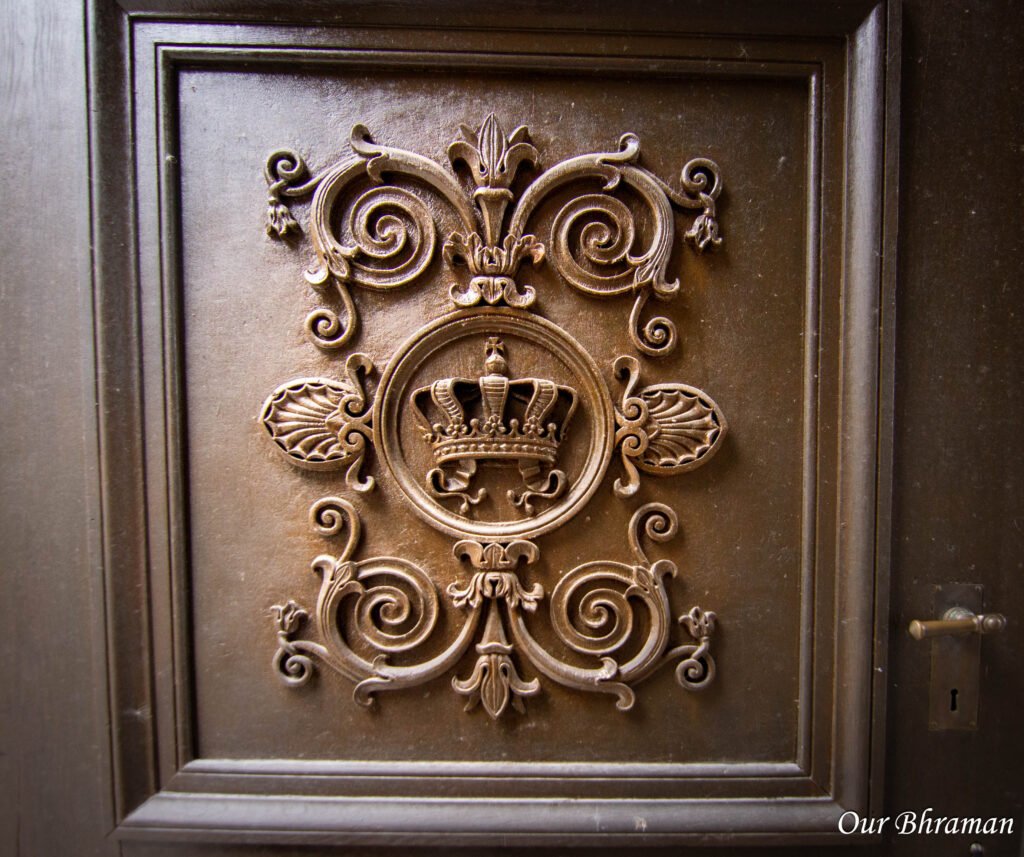
Our next stop was the Munich Residenz, one of the most important historic buildings in the city and the former home of Bavaria’s rulers. What began as a modest castle in the late 14th century gradually grew into a vast palace complex as the Wittelsbach dynasty expanded its power. For more than 400 years, from 1508 to 1918, the Residenz served as the seat of the Bavarian dukes, electors, and kings.
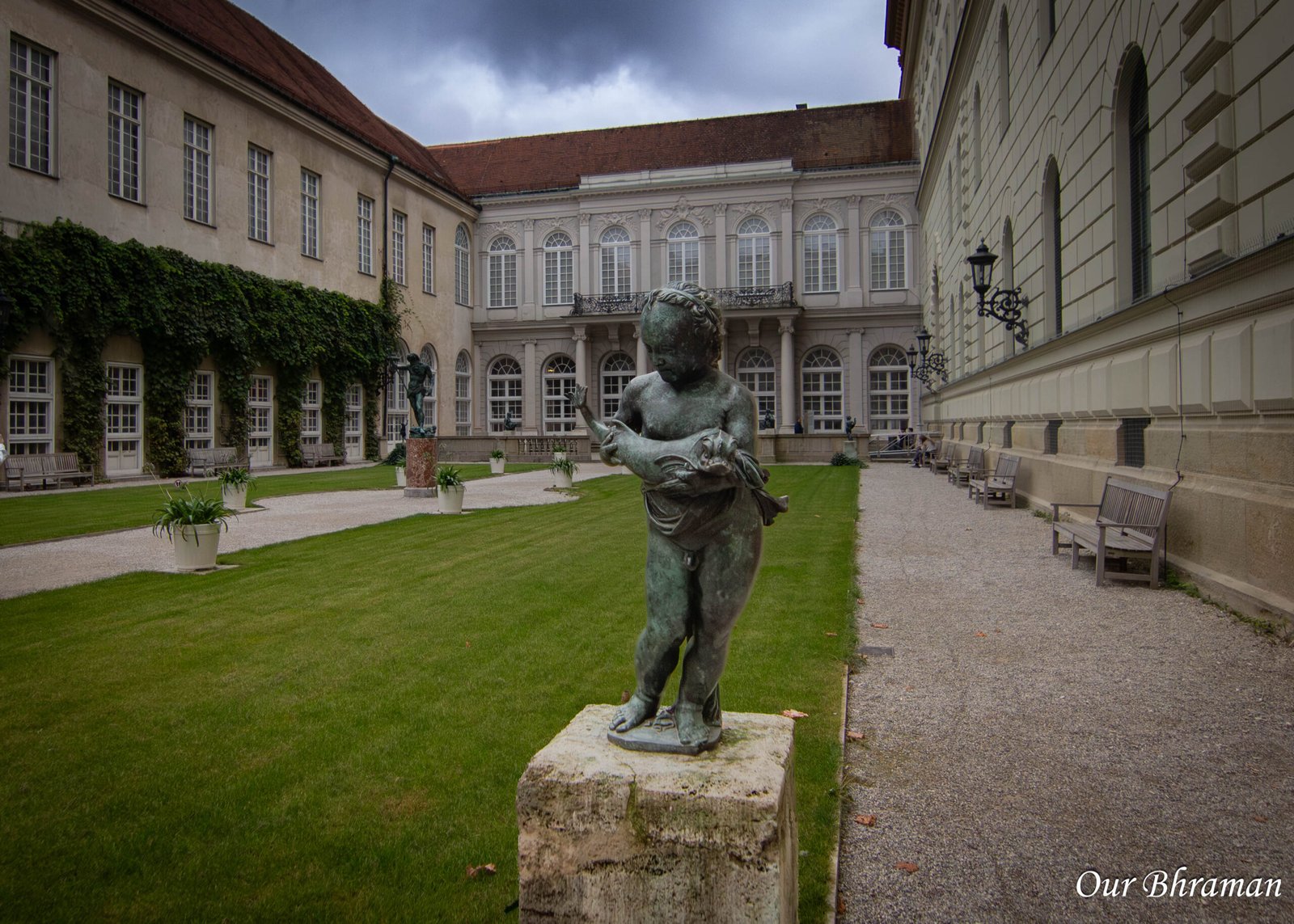 From the outside, the Residenz looks almost understated compared with some of Munich’s more dramatic landmarks. But behind its walls is a huge complex of courtyards, state rooms, galleries, and apartments that reflect centuries of Bavarian history. Different rulers added and redesigned sections of the palace over generations, creating a mixture of architectural styles rather than one single look.
As our tour continued, we came across the Kaiserhof, or Emperor’s Courtyard, one of the most impressive courtyards within the Residenz. Surrounded by elegant arcades and historic buildings, the courtyard gave us a glimpse of the grandeur associated with Bavaria’s former rulers. The symmetry of the architecture, the detailed façades, and the open courtyard made it easy to understand why the Residenz was built to impress.
At the center of the courtyard, we noticed the Fountain of the Wittelsbachs, while the surrounding architecture and Bavarian lion sculptures added to the royal character of the space. Standing there, we could imagine this courtyard centuries ago, when it was part of the world of Bavaria’s rulers and their court.
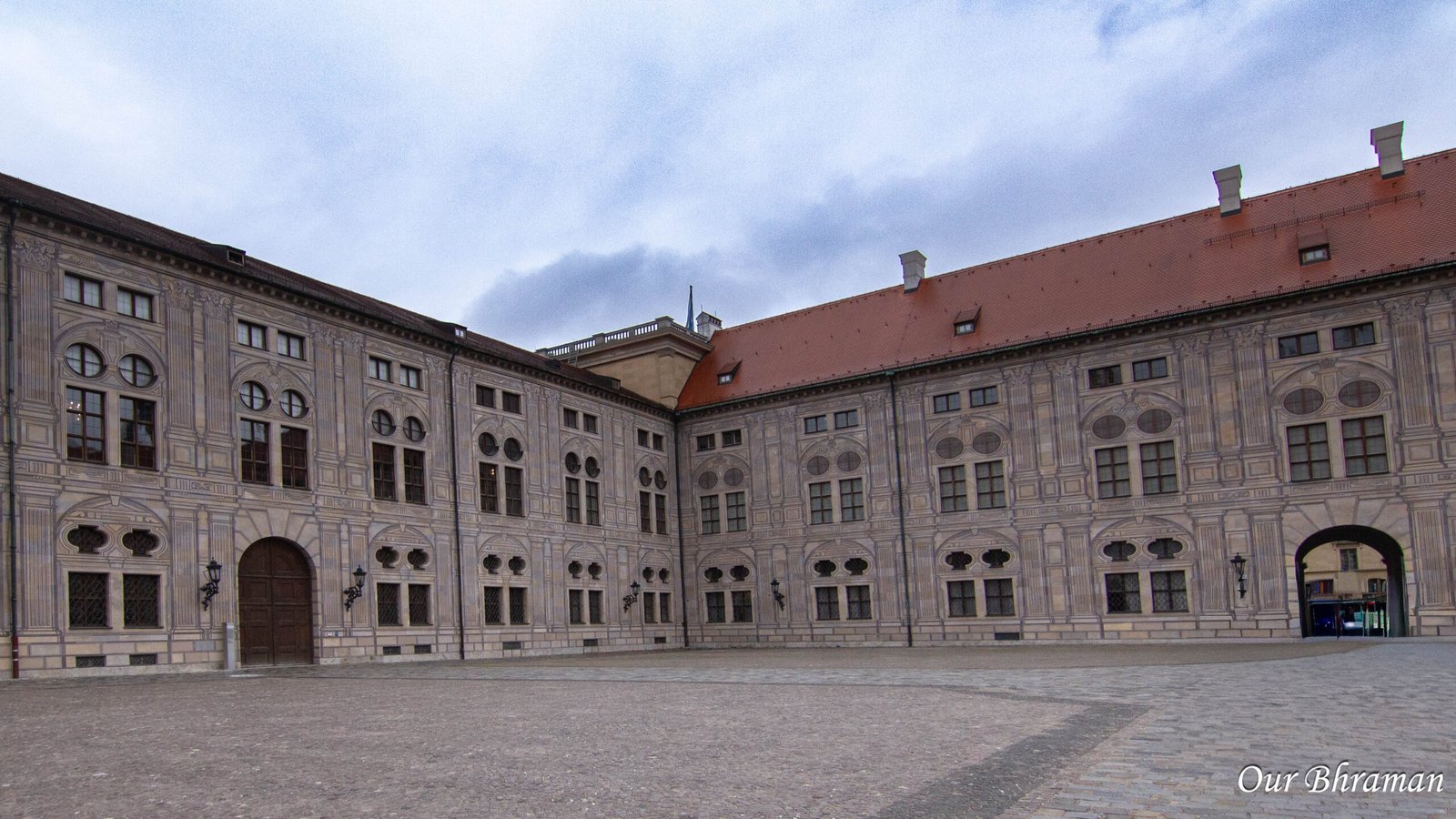 Our guide helped put everything into perspective by connecting the building to the history of the Wittelsbach family and the development of Bavaria. We learned that the Residenz wasn’t simply a royal home—it was also a place where political decisions were made, important guests were received, and the affairs of Bavaria were managed for centuries.
Although we experienced the Residenz as part of our walking tour rather than exploring the entire palace museum, the stop gave us a much better appreciation for Munich’s royal past. The Kaiserhof was one of those places where the architecture, history, and stories from our guide came together, making it much more meaningful than simply seeing the building from the street.
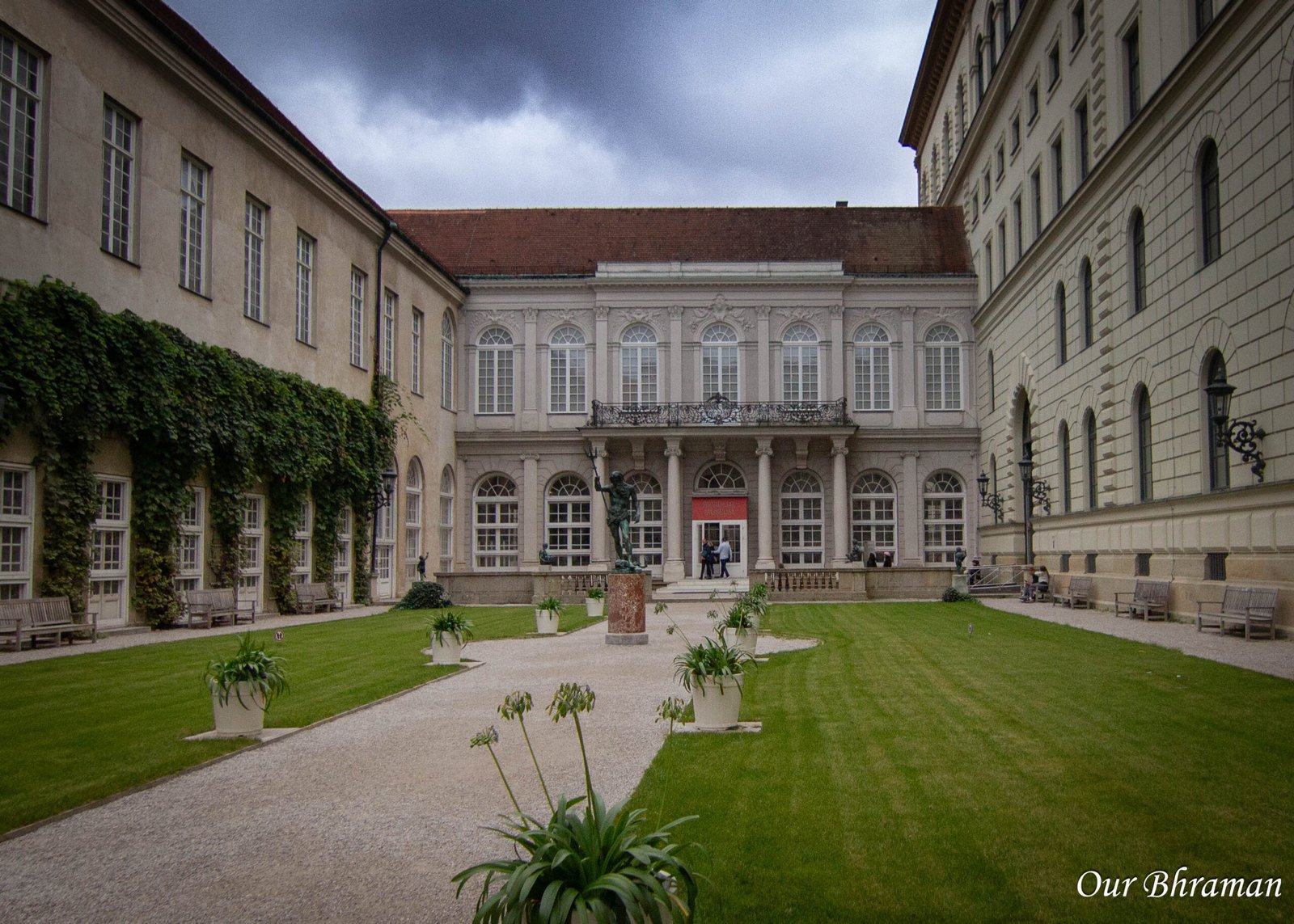
Odeonsplatz & Theatinerkirche
At Odeonsplatz, the scale of the architecture opened up again. The square is surrounded by the Theatinerkirche, Feldherrnhalle, Munich Residence, and Hofgarten.
Here, Matt moved the conversation from architecture into some of the darker chapters of German history. We learned about Munich’s connection to Adolf Hitler and the Nazi movement, including the failed Beer Hall Putsch of 1923, when Hitler and his supporters marched toward the Feldherrnhalle.
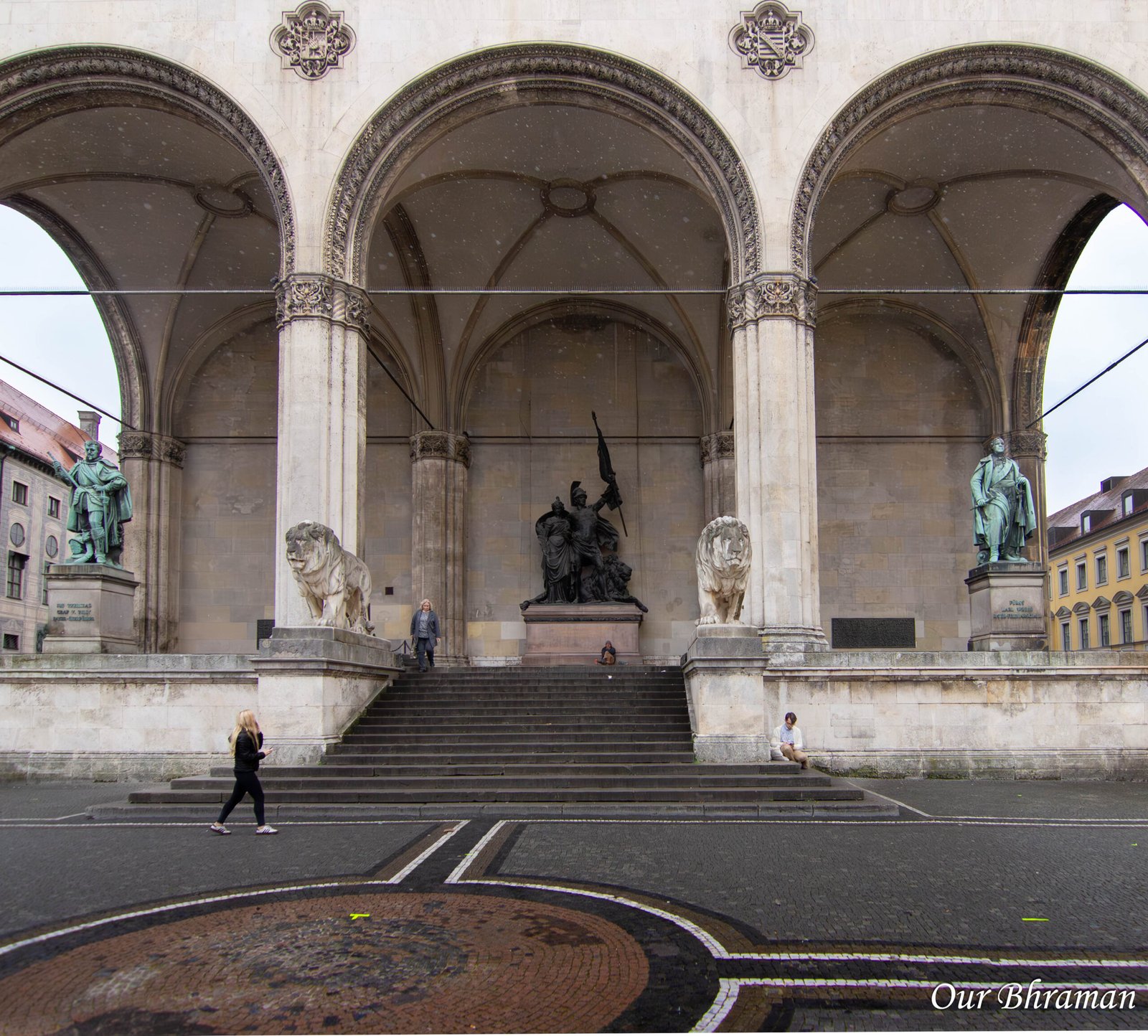
Standing in such an elegant part of Munich while hearing about those events created a striking contrast. The same streets and buildings had witnessed very different chapters of the city’s history.
Theatinerkirche — A Quiet Moment at Odeonsplatz
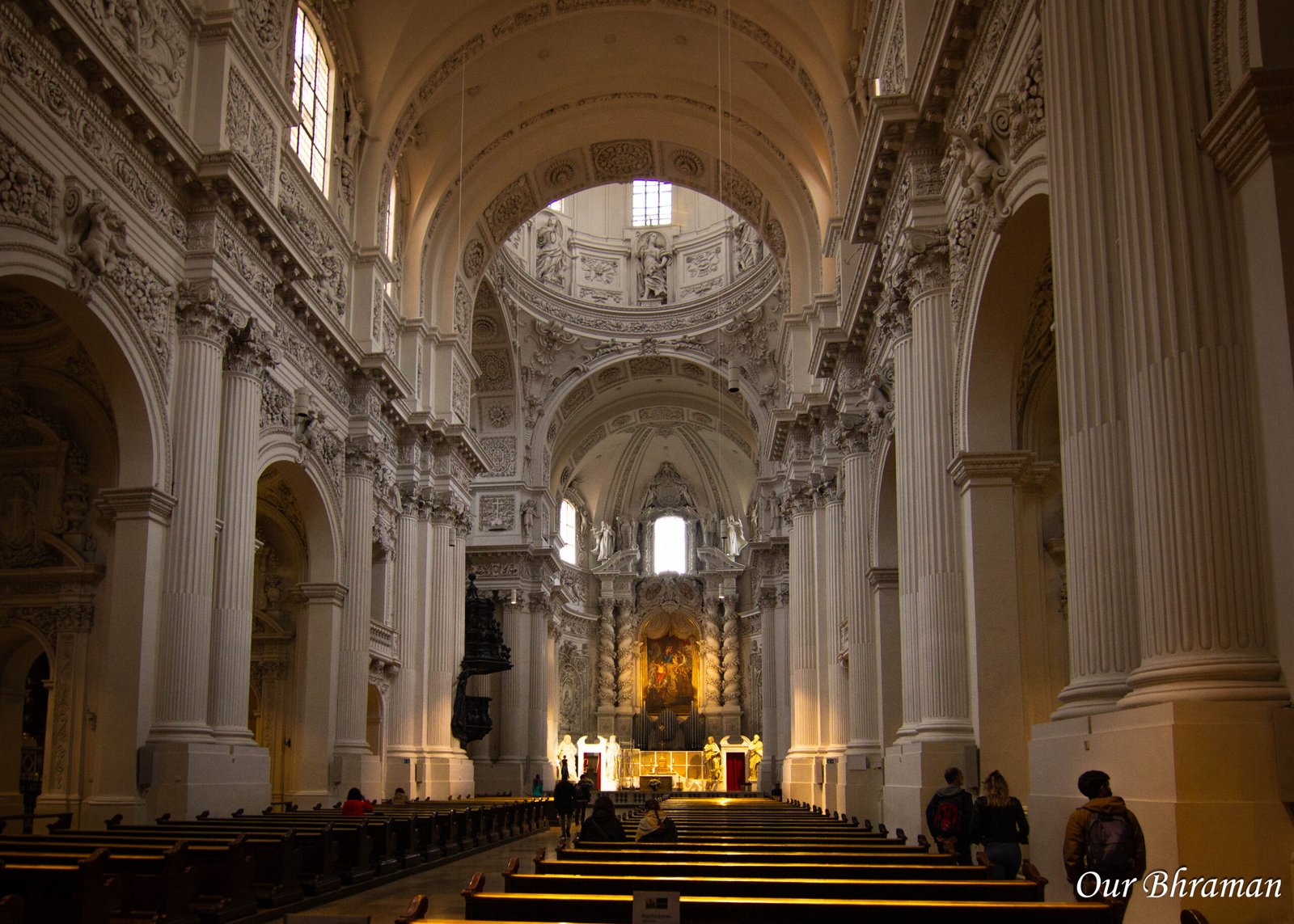
From Odeonsplatz, our walking tour continued into the Theatinerkirche (St. Kajetan), one of Munich’s most recognizable Baroque churches. After the busy streets and stories we had been following, stepping inside felt like a change of pace. The bright white interior, towering columns, detailed stucco work, and impressive dome made the church feel both grand and peaceful. We took a few moments to look around and appreciate the architecture before continuing our walk toward Viscardigasse and the Munich Residenz.
Viscardigasse — A Small Street With a Bigger Story
One of the stops we probably would have walked past without a guide was Viscardigasse, a narrow passage behind the Feldherrnhalle.
This little street carries a remarkable story from the Nazi period. After the failed 1923 putsch, the Feldherrnhalle was later turned by the Nazi regime into a site of propaganda and commemoration. People were expected to give the Nazi salute when passing a memorial there. Some residents reportedly avoided doing so by taking this small side street instead. This led to its nickname, “Drückebergergassl,” roughly referring to people who were avoiding the required salute. Today, a bronze trail called “Argumente” commemorates this act of quiet refusal.
This was one of the moments when the tour really stayed with us. It wasn’t a grand monument or famous attraction—it was simply a narrow street with a story that connected an ordinary place to a difficult part of history.
Maximilianstraße — Munich’s Grand Boulevard
From the historic buildings, we eventually reached Maximilianstraße, one of Munich’s most famous boulevards.
The street has a very different character. Today, it is known for luxury shops, elegant storefronts, hotels, galleries, and impressive architecture. But Matt explained that the street itself was part of a much larger 19th-century vision for Munich. King Maximilian II commissioned the boulevard, which was designed by architect Georg Friedrich Bürklein in what became known as the “Maximilian style,” blending elements including Neo-Gothic and Renaissance influences.
For us, this was less about shopping and more about simply walking the street and looking at the architecture and atmosphere.
More Than Just a Walking Tour
What we enjoyed most about the tour wasn’t simply the number of places we saw. Matt connected the places together. A church wasn’t just a church, a narrow street wasn’t just a shortcut, and a grand square wasn’t just another photo stop.
His stories about Munich’s history, local legends, Bavarian royalty, Hitler and the Nazi era, World War II, architecture, and everyday life gave us a different way to look at the city.
For us, that was the value of taking a walking tour. We could have walked the same streets ourselves, but we wouldn’t have seen them in quite the same way.