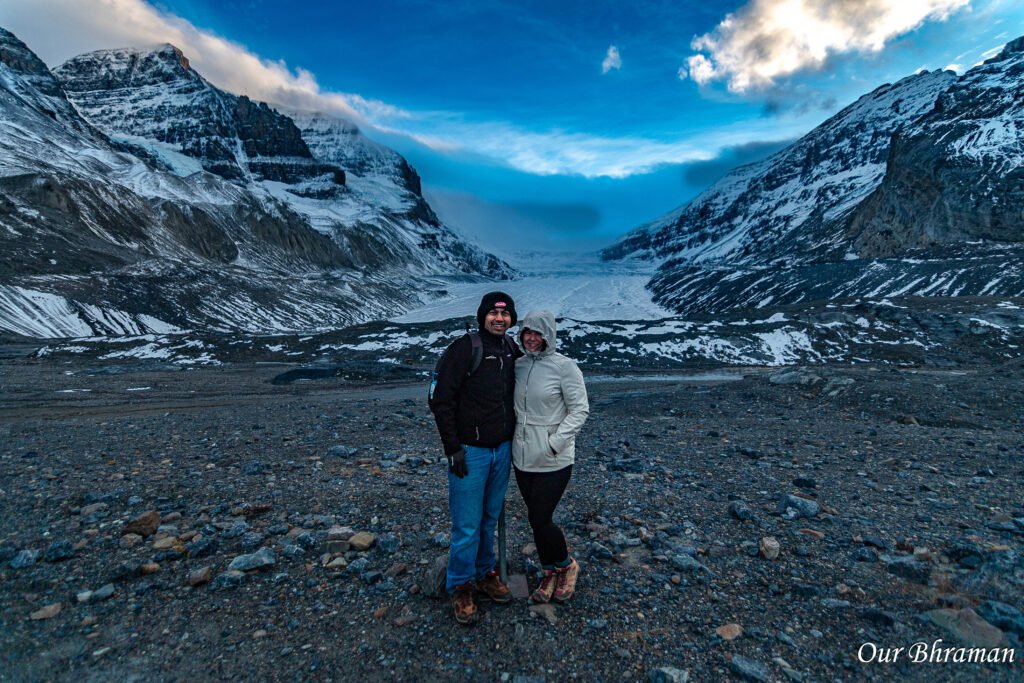
Columbia Icefields & Athabasca Glacier
There are places in the Canadian Rockies where you feel like you’re simply visiting a beautiful landscape. And then there are places that make you feel very, very small. The Columbia Icefields was one of those places for us.
After spending the day making our way along the spectacular Icefields Parkway, we arrived at one of the most impressive landscapes of our Canadian Rockies adventure: the Athabasca Glacier.
Towering mountains surrounded us on every side, enormous walls of rock rose into the sky, and the glacier stretched across the valley like a frozen river. We were excited. We were also completely unprepared for just how cold it was going to be.
The Columbia Icefields
Located along the Icefields Parkway between Banff and Jasper National Parks, the Columbia Icefields are one of the most spectacular stops in the Canadian Rockies. The icefield covers a vast area high in the Canadian Rockies and feeds several major glaciers, including the Athabasca Glacier.
For many travelers driving between Banff and Jasper, this is one of the major highlights of the entire journey. And once you see it for yourself, it’s easy to understand why. The mountains surrounding the icefield seem almost endless. Snow and ice cling to the peaks, while enormous valleys stretch between them.
The scale is difficult to comprehend from photographs. You really have to stand there.
Hiking to the Toe of the Athabasca Glacier
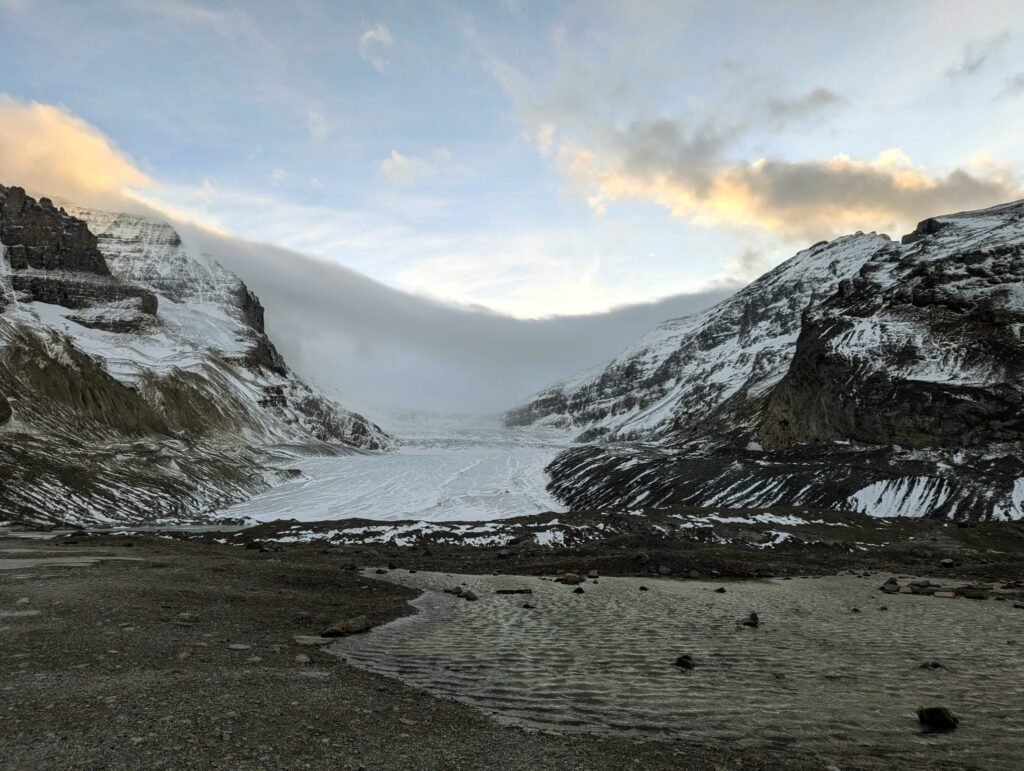
Our next stop was the Toe of the Athabasca Glacier.
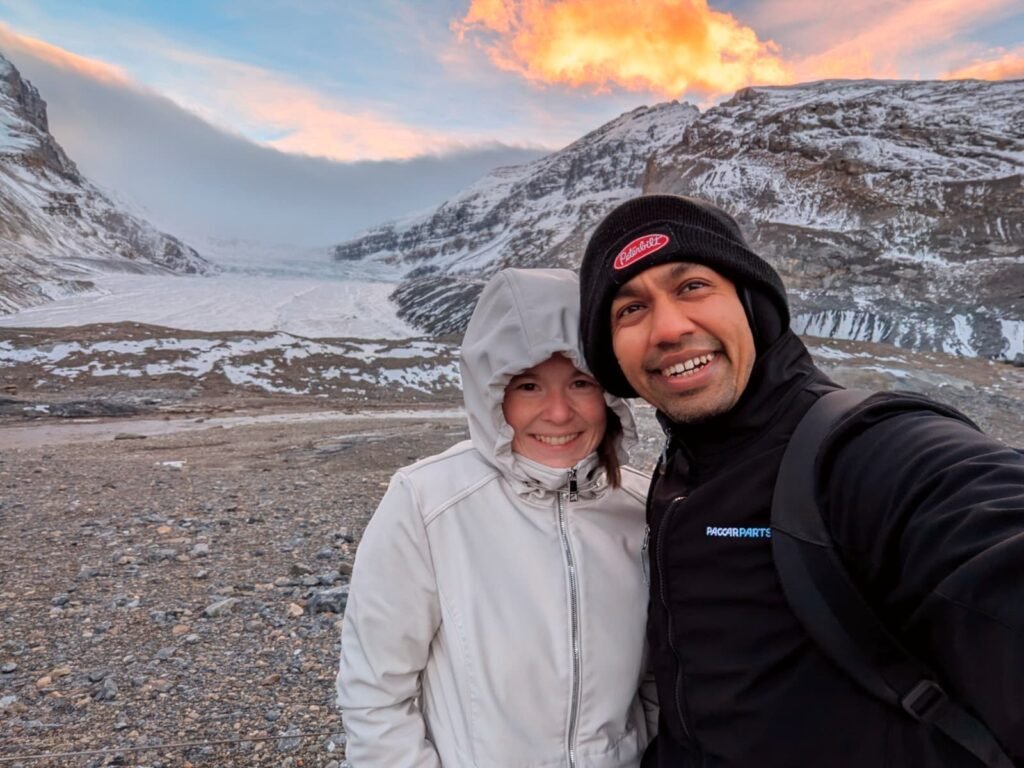
We had already spent much of the day exploring, so we were ready for another adventure—but perhaps not quite ready for the weather that was waiting for us. The hike to the toe of the glacier is less than 2 km round trip, but on this particular day, it felt much longer. Why? The wind. And the cold. With temperatures hovering around freezing, the entire hike felt like we had stepped inside a giant refrigerator. We bundled up as best we could and started walking.
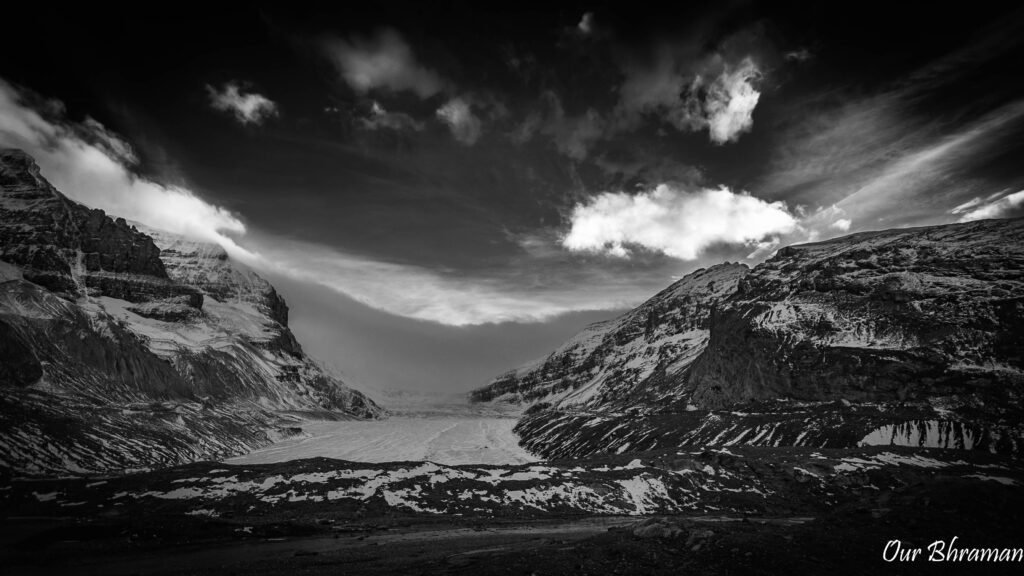
The trail winds through the rocky valley toward the glacier, with the surrounding mountains providing an incredible backdrop the entire way. Even before reaching the glacier, the scenery was spectacular. But as we continued toward the ice, something else began to catch our attention. The landscape itself was telling a story.
Walking Through Glacial History
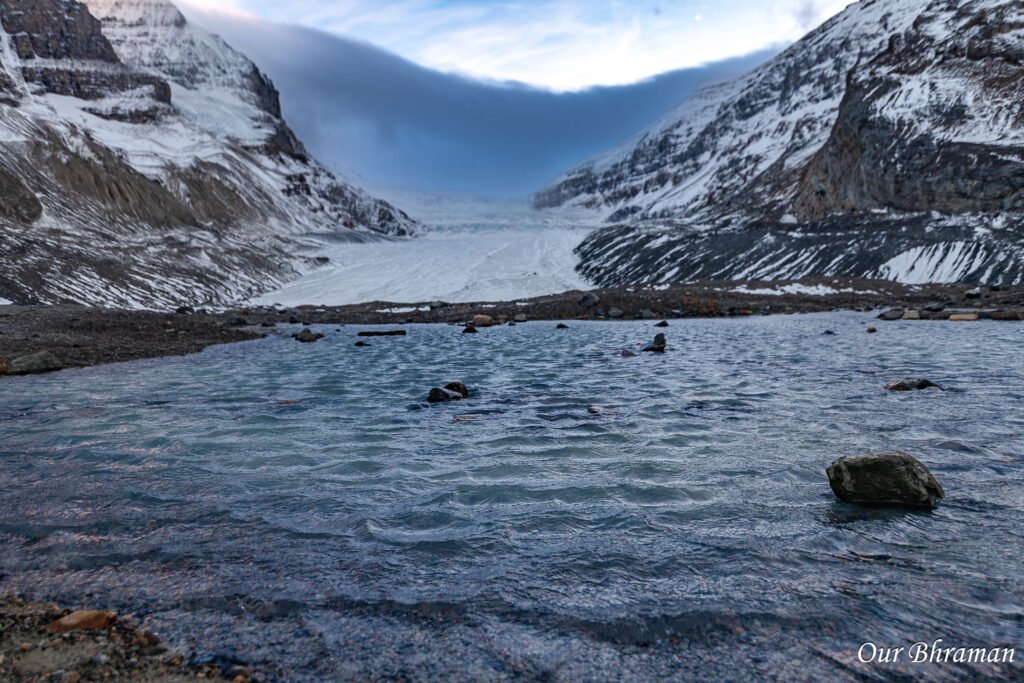
Along the trail, interpretive signs explain the formation and history of the Athabasca Glacier. But these signs aren’t simply about how glaciers form. They also tell a much more sobering story. The glacier is retreating.
Over the years, markers and historical photographs document just how far the ice once extended compared with where it sits today. Seeing those changes in person was eye-opening. You aren’t simply looking at a glacier. You’re looking at evidence of a landscape that is changing in real time.
The information along the trail gave us a completely different perspective on what we were seeing. The glacier suddenly felt less like a static attraction and more like a living record of the Earth’s climate and geological history.
Standing Before the Athabasca Glacier
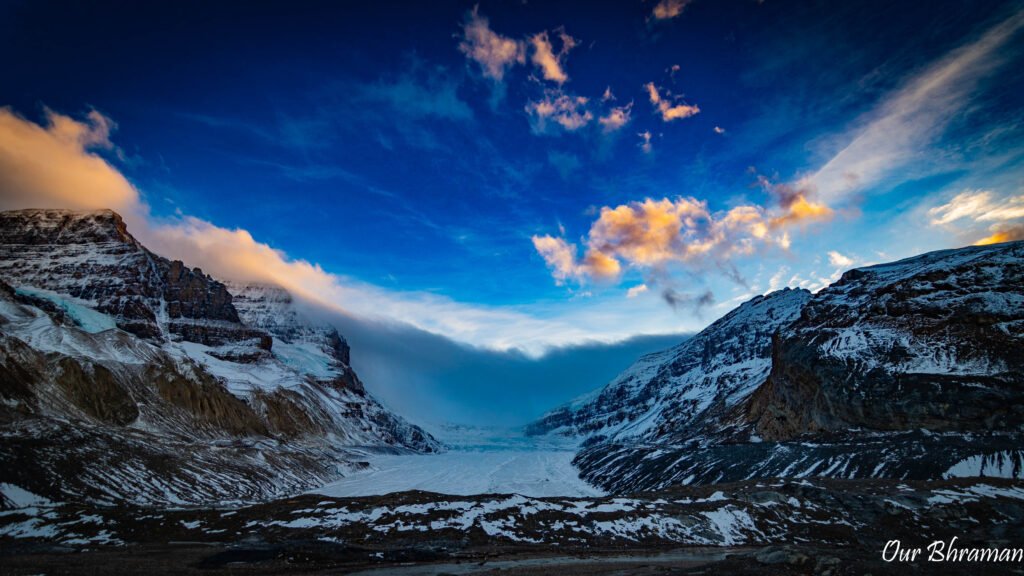
From the rock bench, we finally had an unobstructed view of the glacier’s edge. The ice shimmered in the daylight, surrounded by massive mountains and the rugged landscape of the Columbia Icefields. Even with the cold wind blowing around us, we stood there for a few minutes simply taking it all in. It was one of those moments where you don’t really know what to say.
So we took photographs. Lots of them. Because when you’re standing in front of something this incredible, your first instinct as photographers is to try to capture it. But no photograph could really convey the feeling of standing there. The cold. The wind. The silence. The enormous scale of the mountains. And that wall of ancient ice sitting in front of us.
What Else Can You Do at the Columbia Icefields?
Although our experience focused on hiking to the toe of the Athabasca Glacier, there is much more to do at the Columbia Icefields.
If you have more time than we did, this is a place where you could easily spend several hours.
Ride an Ice Explorer Onto the Glacier
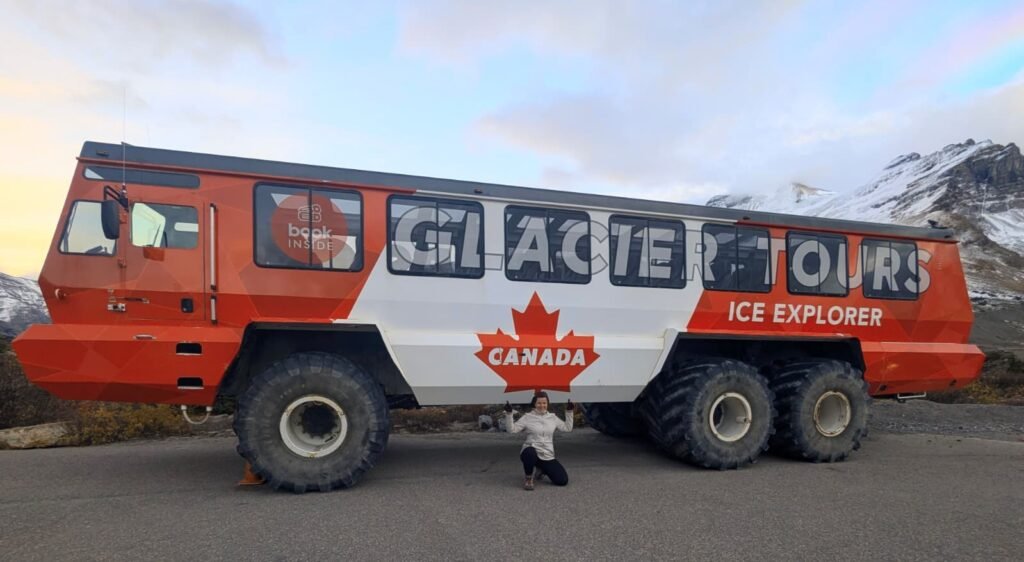
One of the most popular Columbia Icefields experiences is the Columbia Icefield Adventure, which takes visitors onto the Athabasca Glacier in a massive Ice Explorer vehicle. These specially designed vehicles travel directly onto the glacier, allowing visitors to step out onto the ice.
It’s a completely different experience from hiking to the toe. Instead of viewing the glacier from a distance, you actually get the opportunity to stand on the ice itself.
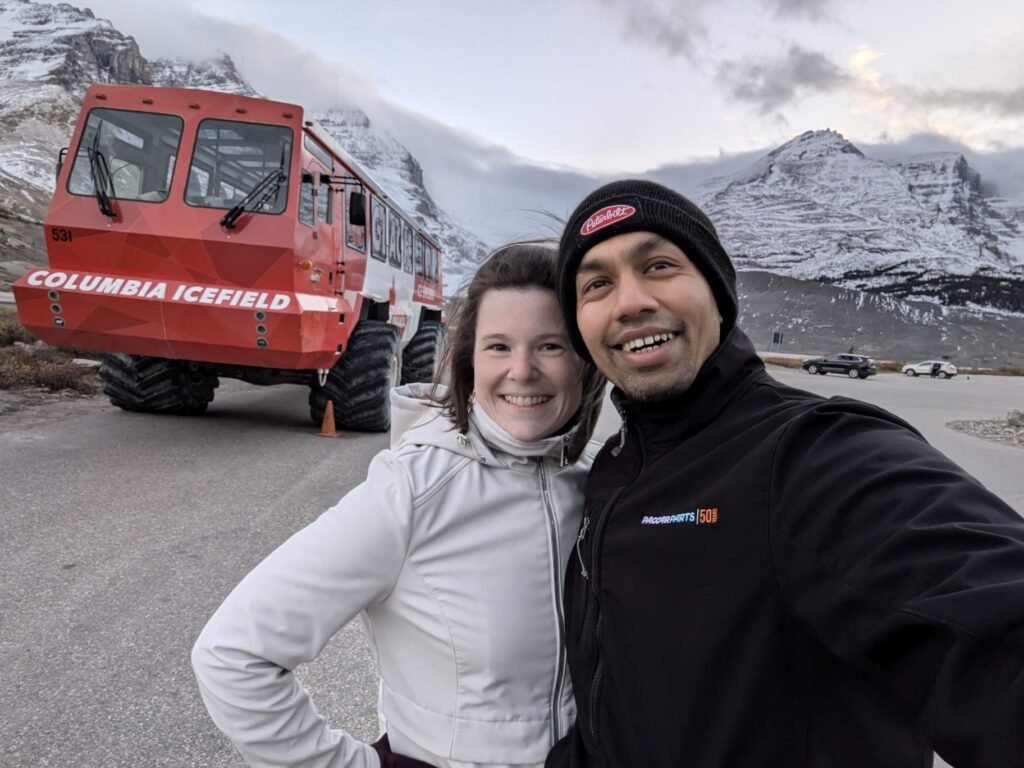
We unfortunately didn’t have enough time to do this during our visit—but seeing the enormous Ice Explorer vehicles in the parking area definitely gave us something to add to our Canadian Rockies bucket list.
Walk the Glacier Skywalk
Another major attraction is the Glacier Skywalk, located farther along the Icefields Parkway. The glass-floored observation platform extends over the Sunwapta Valley and provides dramatic views of the mountains and valley far below.
If you’re someone who loves heights, photography, or dramatic viewpoints, this is an experience worth considering. The Skywalk can also be combined with the Icefield Adventure as part of a longer visit to the Columbia Icefields.
Visit the Glacier Discovery Centre
The Glacier Discovery Centre is located directly across from the Athabasca Glacier parking area and serves as the hub for many of the Columbia Icefields experiences. Inside, you can learn more about the glaciers, geology, and natural history of the region. There are also places to grab food and take a break.
Unfortunately, this was one experience we missed. By the time we arrived, we were a little too late in the day to properly explore the visitor centre. It was definitely a bit of a letdown. But rather than being disappointed for too long, we decided to look at it differently. Now we have a reason to come back.
And Of Course, We Had to Get a Picture
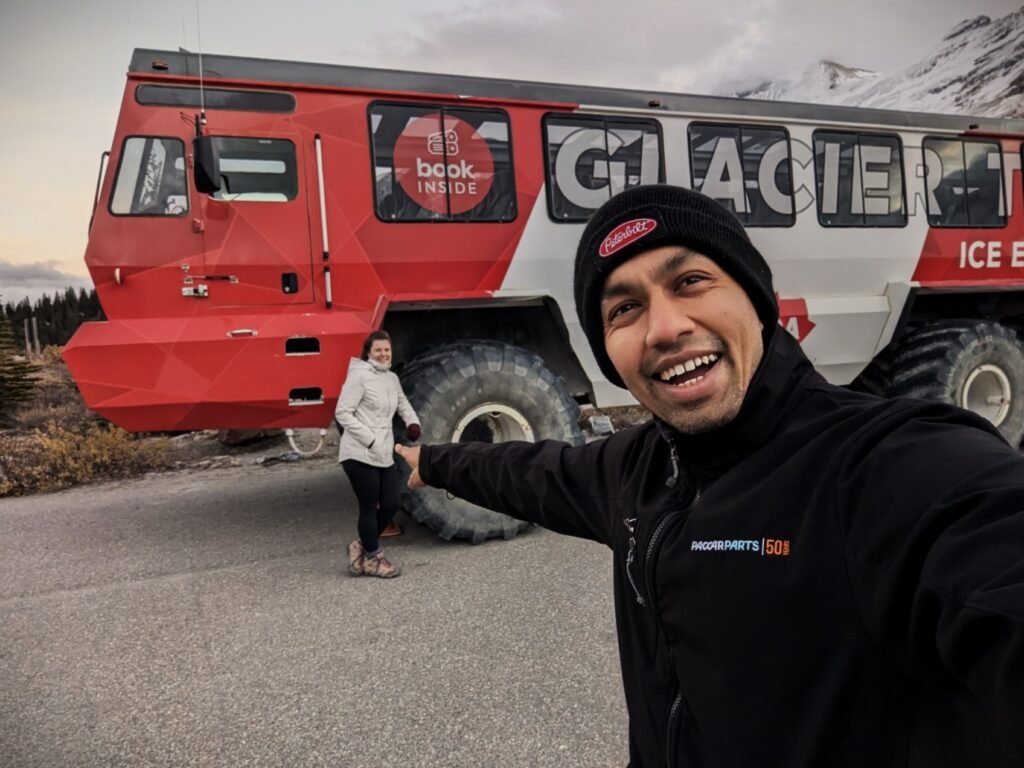
After finishing our hike, we headed toward the parking area near the Glacier Discovery Centre. There, sitting in the parking lot, were those enormous Ice Explorer vehicles. After seeing photographs of these vehicles before our trip, we couldn’t resist getting a picture with one.
We hadn’t ridden one. We hadn’t walked on the glacier. And we hadn’t made it inside the Discovery Centre. But we had stood at the toe of the Athabasca Glacier, battled the cold, learned about its history, and experienced the landscape on foot. For us, that was enough for one afternoon. And the giant Ice Explorer made for a pretty good souvenir photo.
How Much Time Do You Need at the Columbia Icefields?
his is one of those stops where the amount of time you need depends entirely on what you want to do.
If you’re simply stopping to hike to the toe of the Athabasca Glacier, you can visit relatively quickly.
But if you want to experience the Ice Explorer, Glacier Skywalk, Discovery Centre, and glacier viewpoint, you’ll want to give yourself considerably more time.
Suggested Time
Quick stop: 1–2 hours
- Athabasca Glacier viewpoint
- Hike to the Toe of the Glacier
- Photos
Half day: 3–5 hours
- Toe of Athabasca Glacier
- Glacier Discovery Centre
- Ice Explorer experience
- Time for food and photography
Longer visit: 5+ hours
- Ice Explorer
- Glacier Skywalk
- Toe of the Athabasca Glacier
- Discovery Centre
- Additional viewpoints and stops along the Icefields Parkway
What to Know Before Visiting
Dress for Winter—Even in Summer
This is probably our biggest lesson. Bring layers. The Columbia Icefields are high in elevation, and weather can be dramatically colder than what you’re experiencing in Banff or Jasper. We visited when temperatures were hovering around freezing, and the wind made it feel even colder. A warm jacket, gloves, hat, and layers can make a huge difference.
Wear Good Shoes
Even the short walk to the toe of the glacier involves uneven terrain. Good walking or hiking shoes are highly recommended.
Bring Your Camera
Obviously, we didn’t need much convincing here. The Columbia Icefields are a photographer’s dream. Wide-angle landscapes, dramatic mountains, glacial ice, meltwater streams, and enormous skies provide endless compositions. Just remember to protect your camera gear from the cold and moisture.
Plan Your Fuel and Food
The Icefields Parkway is remote, and services are limited compared with Banff or Jasper. It’s a good idea to fill your gas tank before heading into the more remote sections of the Parkway and carry snacks and water. We learned quickly that road-trip planning matters out here.
Respect the Glacier
The Athabasca Glacier is beautiful, but it’s also important to remember that a glacier isn’t simply another hiking destination. The ice can contain hidden crevasses, unstable areas, and fast-moving meltwater. Don’t walk onto the glacier unless you’re on an authorized guided experience. For a closer look, stick to designated trails and viewing areas—or book an official glacier experience such as the Ice Explorer.
A Landscape That Is Changing
Perhaps the most memorable part of our visit wasn’t simply seeing the glacier. It was realizing how much it has changed. Standing beside those interpretive signs and seeing the historical markers made the effects of climate change feel much more tangible.
The Athabasca Glacier has been retreating significantly over the past century, leaving behind a visible record of where the ice once stood. You can literally walk through its history. And that makes visiting the glacier feel like more than checking another attraction off a list. It’s an opportunity to see the power of nature—and a reminder of how quickly these landscapes can change.
Columbia Icefields: Our Takeaway
The Columbia Icefields is more than a quick roadside stop along the Icefields Parkway. It’s one of those places where geology, climate, adventure, and scenery all come together.
Whether you simply hike to the Toe of the Athabasca Glacier, take an Ice Explorer onto the ice, walk above the valley on the Glacier Skywalk, or spend time learning about the region at the Discovery Centre, it’s worth making time for.
For us, it became one of the most memorable stops of our Canadian Rockies road trip. And despite the freezing wind, tired legs, and everything we didn’t get to see…we wouldn’t have skipped it for anything.
The Canadian Rockies have a way of making you feel small. The Columbia Icefields reminded us just how powerful—and temporary—these landscapes can be.