
A Different Side of Geneva — Where Travel Becomes a Lesson in Humanity
When we think of Geneva, Lake Geneva, the Jet d’Eau, historic streets, and international organizations often come to mind. But Geneva also played an important role in shaping modern humanitarian action.
That brought us to the International Red Cross and Red Crescent Museum, located near the United Nations and the International Committee of the Red Cross headquarters. Rather than traditional displays, the museum uses photographs, historical objects, personal stories, multimedia, and large installations to explore the human impact of war, disasters, displacement, and family separation.
We arrived expecting to learn about the Red Cross. We left thinking more about the people behind the stories.
 Before You Go: What Should You Expect?
 Before You Go: What Should You Expect?
The museum is located at 17 Avenue de la Paix, in Geneva’s international district. It is about a 10-minute walk from Place des Nations, and buses also stop nearby at Appia.
The museum is open Tuesday through Sunday, 10:00 AM–5:00 PM, with extended hours until 8:00 PM on Thursdays. It is closed Mondays.
Current admission As of 2026:
- Adults: CHF 15
- Reduced admission: CHF 10
- Children under 12: Free
- Audio guide: CHF 2
- The standard ticket gives access to both the permanent and temporary exhibitions.
The museum recommends allowing about 90 minutes for a visit. If you enjoy taking your time with the historical information, listening to the audio guide, and exploring the interactive displays, I would personally plan for 1½–2 hours.
Don’t treat this as a quick photo stop. Some of the most meaningful parts of the museum are not the displays themselves, but the stories, history, and explanations behind them. Taking a little extra time makes the visit much more worthwhile.

Arriving at the Museum
Even before entering, the building itself caught our attention.
The museum has a modern glass-and-concrete design, with large Red Cross and Red Crescent symbols incorporated into the architecture. The glass walls reflect the surrounding structures and sky, while the giant fabric canopies overhead carry the familiar humanitarian symbols.
It felt appropriate that a museum about humanitarian action did not look like a traditional historical building.
 The architecture immediately gave us the feeling that this would be a different kind of museum—one that would use space, light, sound, images, and design to tell its story.
Photo opportunity: The exterior is worth photographing before entering. Try including the Red Cross/Red Crescent canopies and reflections in the glass.
Inside the Museum: More Than History
The exhibition we experienced, The Humanitarian Adventure, was organized around three major humanitarian challenges:
- Defending human dignity
- Restoring family links
- Reducing natural risks
These themes were not presented simply as historical facts. The museum used immersive installations and personal stories to make visitors consider how humanitarian action affects ordinary people.
And this is where the museum became much more personal for us.
The Giant Foot — A Powerful First Impression
 One of the first installations that really stayed with us was the giant human foot.
Standing in a darkened room, the enormous foot seemed almost out of place at first. Images were projected across the floor beneath it, surrounding the sculpture with photographs and human stories.
It was visually striking, but the longer we stood there, the less it felt like simply an unusual piece of artwork.
The human foot made us think about movement and vulnerability—people forced to leave their homes, people walking away from places they once knew, and people whose lives can change suddenly because of conflict or disaster.
That was one of the things we appreciated about this museum. It did not always explain everything with a long wall of text. Sometimes it gave us an image or an installation and allowed us to stop and think.
For us, this was one of those moments.
Sometimes a museum doesn’t need to tell you what to feel. It simply gives you something to think about.
 The People Outside — A Crowd Without a Voice
 The People Outside — A Crowd Without a Voice
Outside the museum, we also noticed a group of roughly human-sized figures standing together near the glass walls.
Their faces were largely indistinguishable, and their simple clothing gave them an almost anonymous appearance. Yet seeing them gathered together was striking. Each figure represented an individual, but together they seemed to become part of something much larger—a visual reminder of how individual lives can become part of a much bigger humanitarian story.
What made the installation even more interesting was the way the figures interacted with the building. Their reflections appeared repeatedly in the glass, making it look as though there were far more people surrounding the museum.
For us, the scene created an unexpected connection to the museum’s larger theme: individual people becoming part of a much larger human story. Standing there, we found ourselves thinking about how humanitarian work is ultimately about people—not numbers, borders, or politics, but individuals and the lives behind their stories.
It also became one of our favorite photographs from the museum. The combination of the figures, the glass architecture, and their repeated reflections gave the image a sense of depth and made us stop for a moment before heading inside.
The Chains — A Walk Through Separation
Another installation that immediately changed the atmosphere was the room filled with hanging chains.
Walking through the chains felt very different from looking at a conventional museum display.
The narrow pathways created a feeling of restriction and uncertainty. We had to move slowly and carefully, with chains surrounding us on almost every side.
It made the idea of separation feel physical rather than abstract.
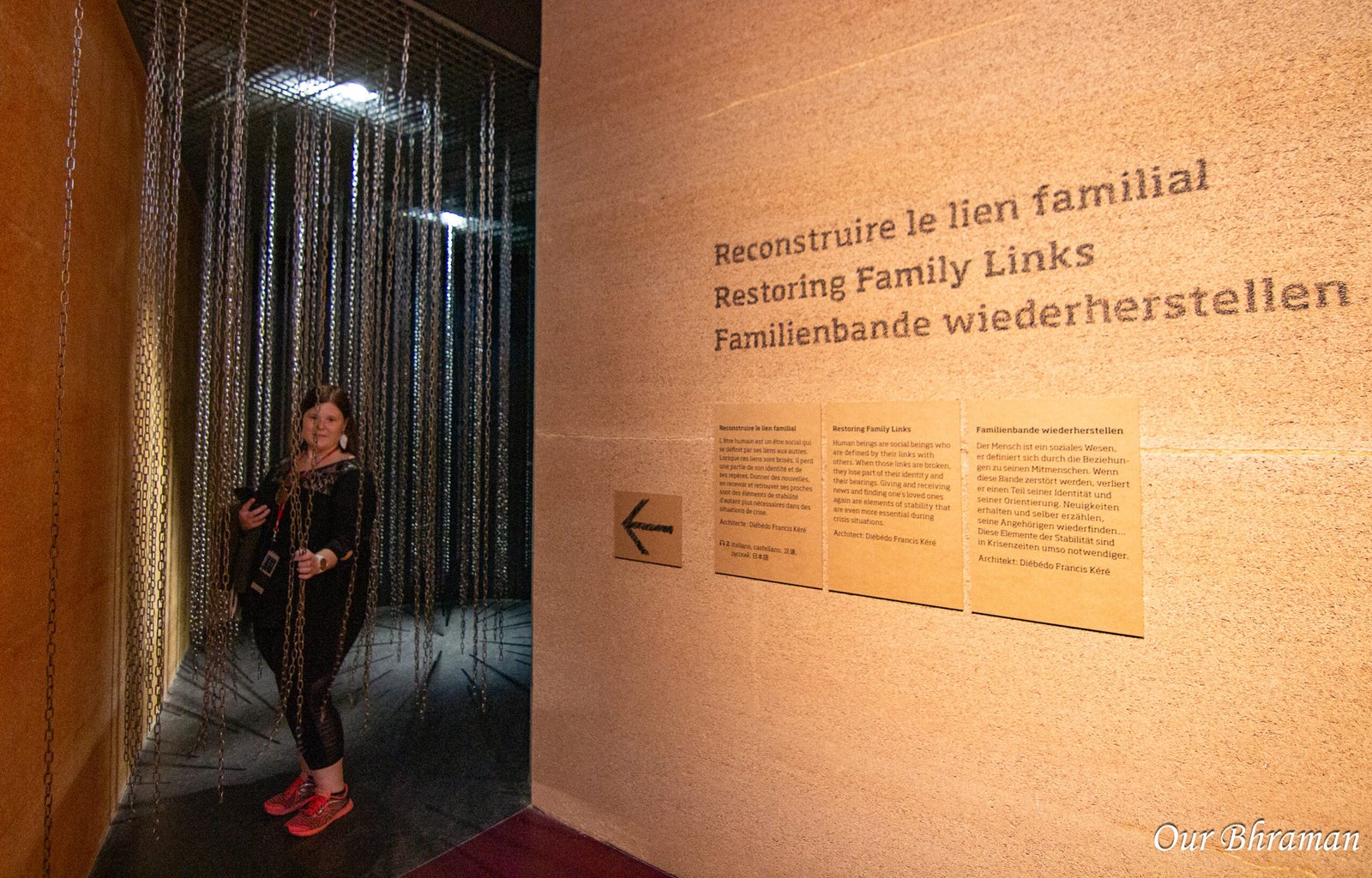 This connected particularly well with the museum’s theme of restoring family links. During wars and other crises, people can lose contact with parents, children, spouses, and friends. The Red Cross and Red Crescent Movement has historically played an important role in helping people restore contact with separated family members. During the First World War, for example, the ICRC established a Prisoners of War Agency in Geneva to help restore contact between captured soldiers and their families.
Standing inside the chains, that history felt much less like something we were simply reading in a museum.
It felt personal.

The Story Behind the Red Cross Begins in Geneva
This is an important part of the museum to slow down for.
The story begins with Henry Dunant, a Genevan businessman who witnessed the aftermath of the Battle of Solferino in Italy in 1859. He was shocked by the number of wounded soldiers who were left without adequate care.
Dunant later wrote A Memory of Solferino, published in 1862, arguing for better care for wounded soldiers and for international agreements to protect them.
In February 1863, Dunant and four other Geneva-based founders formed the committee that became the International Committee of the Red Cross. In August 1864, governments adopted the First Geneva Convention, creating an international legal framework for protecting wounded soldiers.
That history gives Geneva a significance that goes far beyond being a beautiful Swiss city.
Geneva helped give birth to modern international humanitarian law.

Don’t Miss: The Prisoners-of-War Collection
One of the most fascinating historical subjects to look for is the museum’s material connected with prisoners of war and family tracing.
The museum highlights the archives of the International Prisoners-of-War Agency from 1914–1923, which contain approximately six million index cards documenting what happened to two million prisoners of war and interned civilians during the First World War.
That number is difficult to imagine.
Six million cards represent millions of individual pieces of information—names, identities, movements, and attempts to reconnect people with their families.
This is one of the places where we felt the museum’s message most strongly:
Sometimes humanitarian work is not one dramatic rescue. Sometimes it is the patient work of finding one person and helping one family reconnect.
 A Piece of History We Didn’t Expect — Red Cross in India
 A Piece of History We Didn’t Expect — Red Cross in India
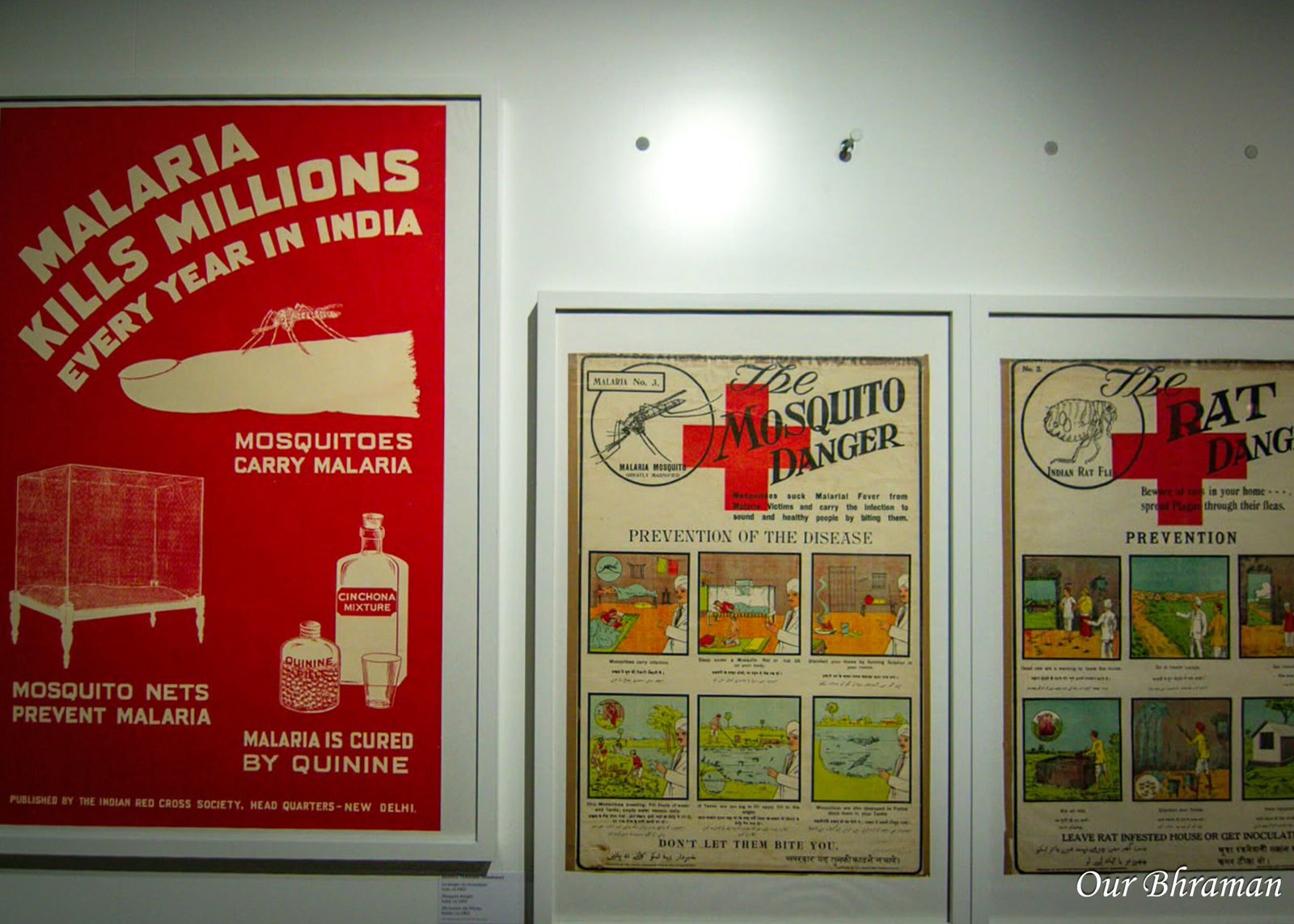
Historical Health Posters from India immediately caught our attention was a collection of historical health posters from India.
The bold red malaria poster stood out to us, connecting the museum’s global story with a place that felt much more familiar. The posters also showed how humanitarian work extends beyond emergency response to public health education and disease prevention.
For us, it was an unexpected discovery. We came expecting stories of wars, wounded soldiers, and the Geneva Conventions, but found ourselves looking at something much broader—the many ways humanitarian work can reach people in everyday life.
Audio Guide — Worth Using?
Yes. We used the audio guide during our visit, and it added useful context to exhibits that might otherwise be easy to overlook. For a museum built around stories and ideas, the explanations help connect the displays to the bigger picture.
Our recommendation: For two people, the audio guide is a good choice. It lets you explore at your own pace and spend about 1½–2 hours with the exhibits.
What About a Guided Tour?
If you want a deeper experience, the museum also offers guided tours of the permanent exhibition. These are particularly useful for larger groups or visitors who want to ask questions and learn more about the exhibits and installations.
For us, the audio guide was enough and gave us the flexibility to explore at our own pace.

The Fundamental Principles
The museum also highlights the Red Cross and Red Crescent Movement’s seven principles:
Humanity • Impartiality • Neutrality • Independence • Voluntary Service • Unity • Universality
For us, they reinforced that humanitarian work is ultimately about protecting human life and dignity.
The Museum’s Design
Dark rooms, projections, sculptures, historical posters, and interactive displays made the museum feel more like an experience than a traditional history lesson.
What We Took Away
We came expecting to learn about the Red Cross but left thinking more about the people behind the statistics—families separated by conflict, displaced people, and communities facing disaster.
Sometimes, the places that leave us with more questions than photographs stay with us the longest.
Vision 2028
The museum is undergoing Vision 2028, a major redesign of its permanent exhibition. With changes continuing through 2028, check the museum’s website before visiting for the latest exhibitions and layout.
“We came to learn about the Red Cross, but we left thinking about the people behind the stories.”